
The Alps turn gold late this year, and for a long time: from about 14 October around the Zugspitze to 13 November in the Aosta Valley and the upper Susa Valley. Start in Bavaria, move east through Austria and South Tyrol, then travel west, and you can be in peak larch gold for about four weeks.
The reason is a hot September. At larch height, the mean temperature from 1 September to 5 October (the period our forecast uses, and what "September" means in this guide) ran 1 to 5 °C above 2025. Our model estimates a delay in peak colour of about two days for each additional degree over that period.
We mapped larch-dominated forests across the Alps from three autumns of satellite images and checked the dates against our own webcams in the Dolomites. The result is a forecast for 20 larch areas, including a separate estimate for the Zugspitze and Wetterstein based on ground observations. For each you get the expected peak, the days the gold should hold, and where to look. Forecast made on 5 October 2026.
The 2026 Larch Gold Forecast at a Glance
The gold arrives in three waves: Bavaria, the eastern Alps and the Dolomites first, then Trentino, Friuli and Vinschgau, and the far west last.
For each of 20 larch areas we give three things:
- Expected peak: the day the larch at the area's main height should look its best, with our margin of error in days.
- Gold window: from about four days before the peak to six days after. In 2025 our Dolomites webcams saw each stand hold its gold for 10 to 13 days.
- Where to look: the valleys, roads, lakes and trails with the most larch.
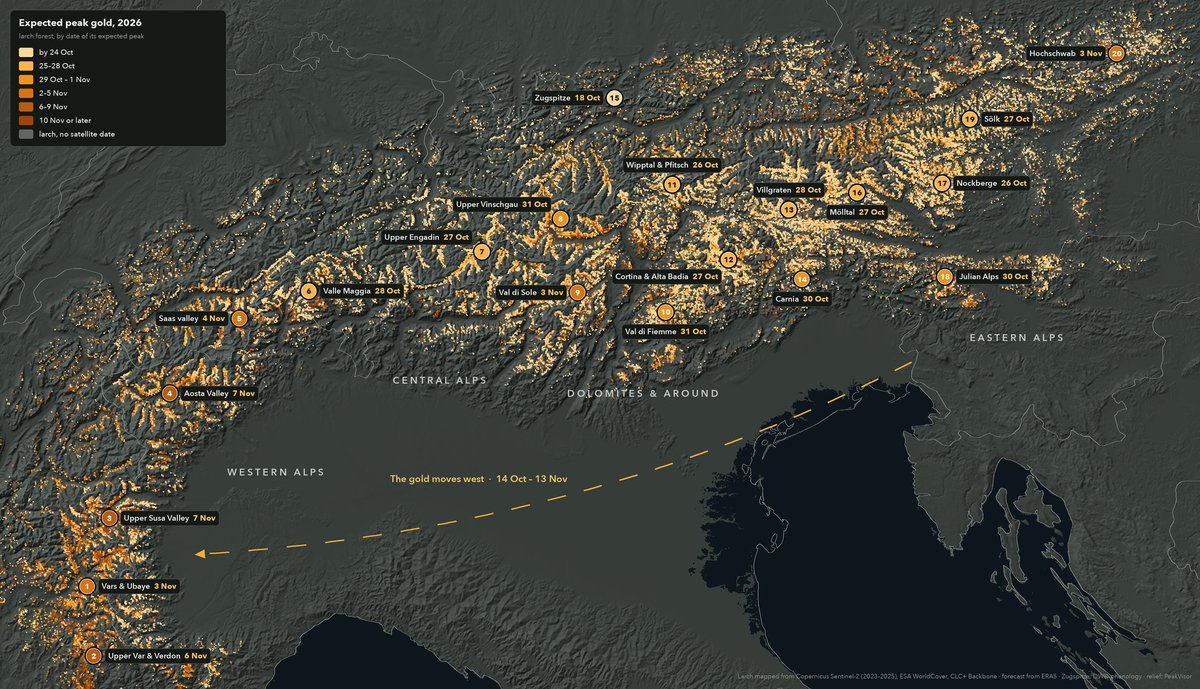
| Expected peak | Area | Gold window | Peak height |
|---|---|---|---|
| 18 Oct ±5 | 15 · Zugspitze & Wetterstein, Germany/Austria | 14–24 Oct | 1,200 m |
| 26 Oct ±3 | 11 · Wipptal & Pfitsch, Italy | 22 Oct – 1 Nov | 1,830 m |
| 26 Oct ±4 | 17 · Nockberge & Turracher Höhe, Austria | 22 Oct – 1 Nov | 1,780 m |
| 27 Oct ±4 | 7 · Upper Engadin, Switzerland | 23 Oct – 2 Nov | 1,990 m |
| 27 Oct ±4 | 12 · Cortina & Alta Badia, Italy | 23 Oct – 2 Nov | 1,860 m |
| 27 Oct ±4 | 16 · Mölltal, Austria | 23 Oct – 2 Nov | 1,760 m |
| 27 Oct ±4 | 19 · Sölk valleys, Austria | 23 Oct – 2 Nov | 1,670 m |
| 28 Oct ±4 | 13 · Villgraten, East Tyrol, Austria | 24 Oct – 3 Nov | 1,830 m |
| 28 Oct ±4 | 6 · Valle Maggia & Formazza, Switzerland/Italy | 24 Oct – 3 Nov | 1,770 m |
| 30 Oct ±4 | 14 · Carnia, Italy | 26 Oct – 5 Nov | 1,700 m |
| 30 Oct ±5 | 18 · Julian Alps, Slovenia | 26 Oct – 5 Nov | 1,620 m |
| 31 Oct ±4 | 10 · Val di Fiemme & Lagorai, Italy | 27 Oct – 6 Nov | 1,830 m |
| 31 Oct ±4 | 8 · Upper Vinschgau, Italy | 27 Oct – 6 Nov | 1,910 m |
| 3 Nov ±4 | 9 · Val di Sole & Peio, Italy | 30 Oct – 9 Nov | 1,930 m |
| 3 Nov ±5 | 1 · Vars & Ubaye, France | 30 Oct – 9 Nov | 2,000 m |
| 3 Nov ±6 | 20 · Hochschwab & Mariazell, Austria | 30 Oct – 9 Nov | 1,280 m |
| 4 Nov ±6 | 5 · Saas valley, Switzerland | 31 Oct – 10 Nov | 1,920 m |
| 6 Nov ±5 | 2 · Upper Var & Verdon valleys, France | 2–12 Nov | 2,030 m |
| 7 Nov ±6 | 4 · Aosta Valley, Italy | 3–13 Nov | 1,950 m |
| 7 Nov ±5 | 3 · Upper Susa Valley & Montgenèvre, Italy/France | 3–13 Nov | 1,980 m |
Dates hold for each area's main larch height. Higher slopes peak a few days earlier, valley floors a few days later.
Follow the Gold: a Four-Week Route
- 14 to 28 October, Bavaria, then Austria, South Tyrol and the Engadin. The Zugspitze and Wetterstein first, then Wipptal and Nockberge, Sölk, Mölltal, Villgraten, Cortina and Alta Badia, and the Upper Engadin.
- 28 October to 3 November, Ticino, Friuli, Slovenia and Trentino. Valle Maggia, Carnia and the Julian Alps, then Val di Fiemme, Upper Vinschgau and Val di Sole.
- 3 to 13 November, the French, Swiss and Italian west. Vars and Ubaye, the Saas valley, the upper Var and Verdon, then the Aosta Valley and the upper Susa Valley to close the season.
Staying in Austria? Hochschwab and Mariazell peak around 3 November, a late encore on lower slopes.
Western Alps: the Grand Finale (Areas 1 to 6)
The Western Alps peak last this year, from Valle Maggia around 28 October to the Aosta Valley and the upper Susa Valley around 7 November. September here was the hottest in the Alps, 11 to 13 °C at the larch and up to 5 °C above 2025, so these dates carry the widest margins.
1. Vars & Ubaye, France
Peak around 3 November (±5 days) at 2,000 m. Gold window: 30 October to 9 November. Last year it peaked on 24 October.
Larch covers the slopes from the Col de Vars (2,109 m) down to Guillestre, and the upper Ubaye around Saint-Paul-sur-Ubaye. For reflections, walk to Lac Miroir above Ceillac, in the Queyras, early on a calm morning. The slopes near 2,200 m turn first, so start high. The trail is listed as open until 1 November, snow permitting. Our Queyras hiking guide has more trails deeper in the Queyras.
2. Upper Var & Verdon Valleys, France
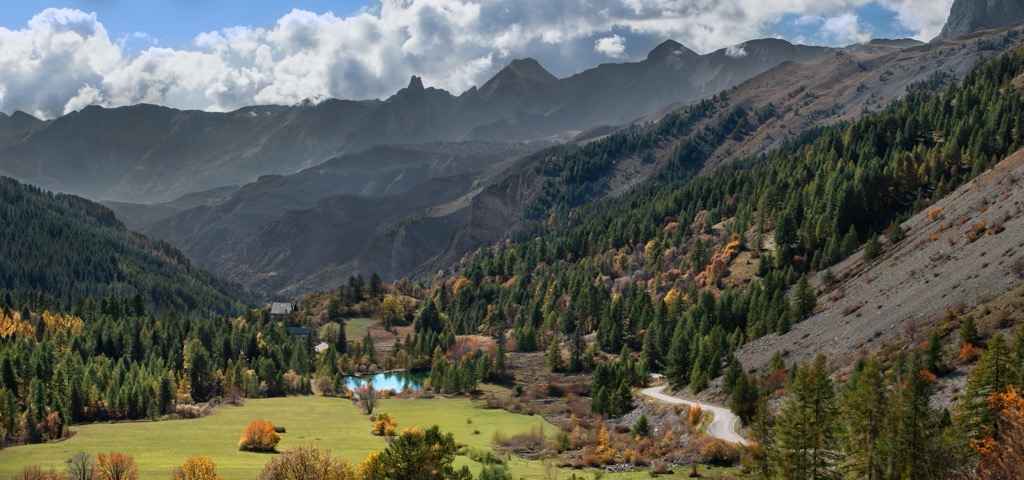
Peak around 6 November (±5 days) at 2,030 m. Gold window: 2 to 12 November. Last year: 28 October.
The headwaters of the Var and the Verdon, on the edge of the Mercantour National Park. Look around Entraunes and Estenc below the Col de la Cayolle, and around Allos and the Lac d'Allos. The road up to the Laus car park above the lake usually stays open until late October, sometimes into early November, snow permitting. Once it closes, the lake is about two and a half hours on foot from the Cluite car park. The Cayolle is a high pass: check it is open before you drive it, above all after snow.
3. Upper Susa Valley & Montgenèvre, Italy/France
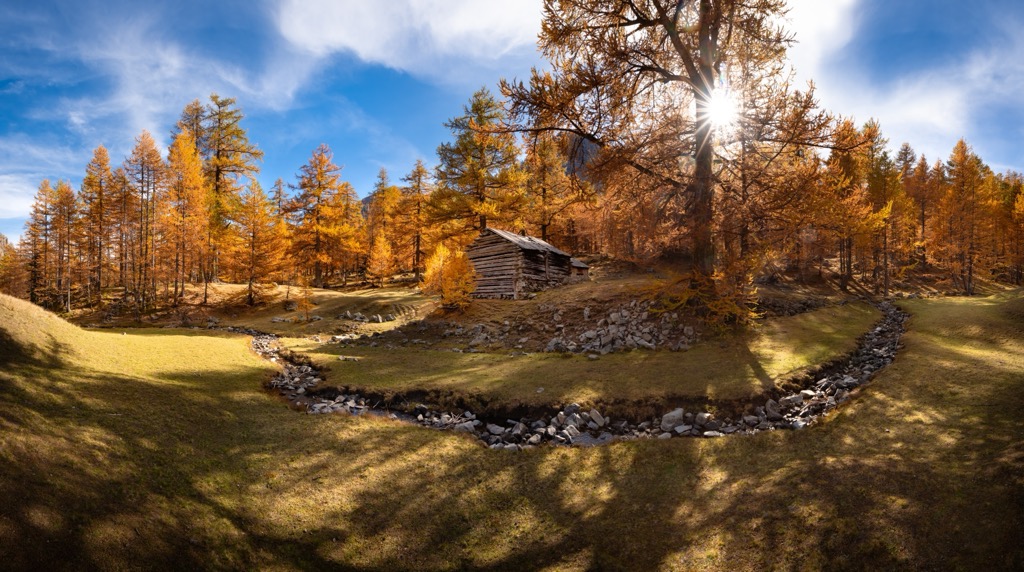
Peak around 7 November (±5 days) at 1,980 m. Gold window: 3 to 13 November. Last year: 4 November.
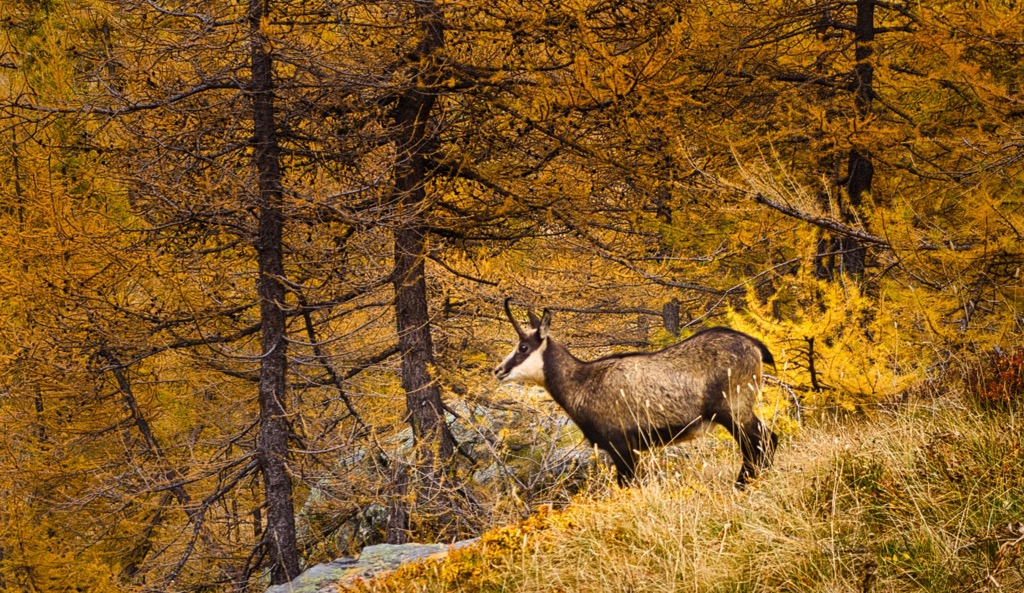
The biggest larch area in this guide, about 98 km² of larch forest in the Cottian Alps around Oulx, Sauze d'Oulx, Bardonecchia, Cesana, Sestriere and Pragelato, with Montgenèvre across the border. Walk the Gran Bosco di Salbertrand or the Val Troncea above Pragelato. This is the last stop of the season.
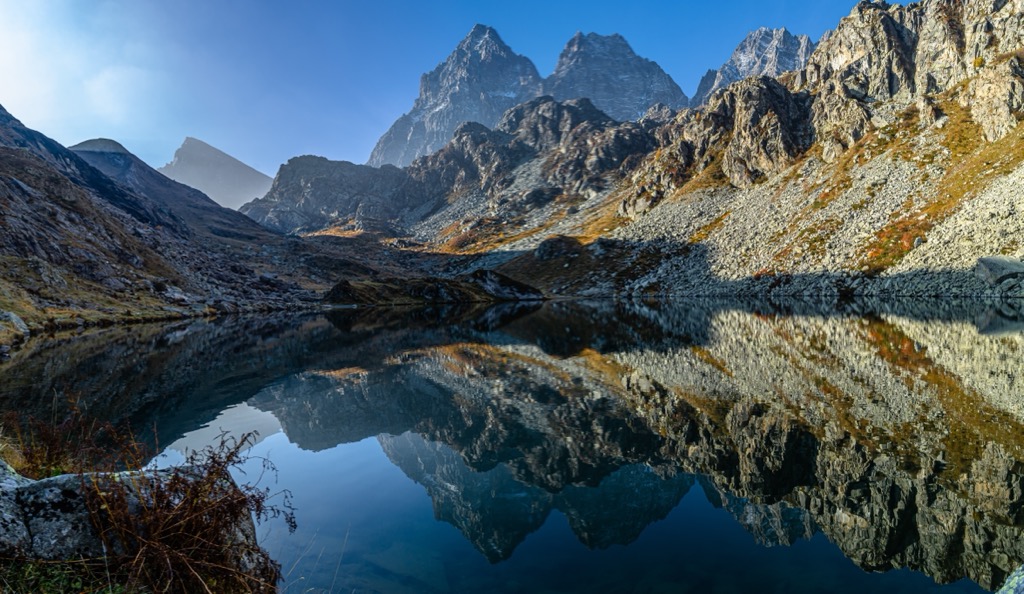
4. Aosta Valley, Italy
Peak around 7 November (±6 days) at 1,950 m. Gold window: 3 to 13 November. Last year: 30 October.
The larch rings the valleys around Aosta, where the Graian Alps meet the Pennine Alps: Pila above the city, the Valpelline and the Great St Bernard valley to the north, and Cogne at the gateway to Gran Paradiso. September here ran 4.2 °C warmer than last year, so the date could move by close to a week either way. Leave a few days of slack in your plans.
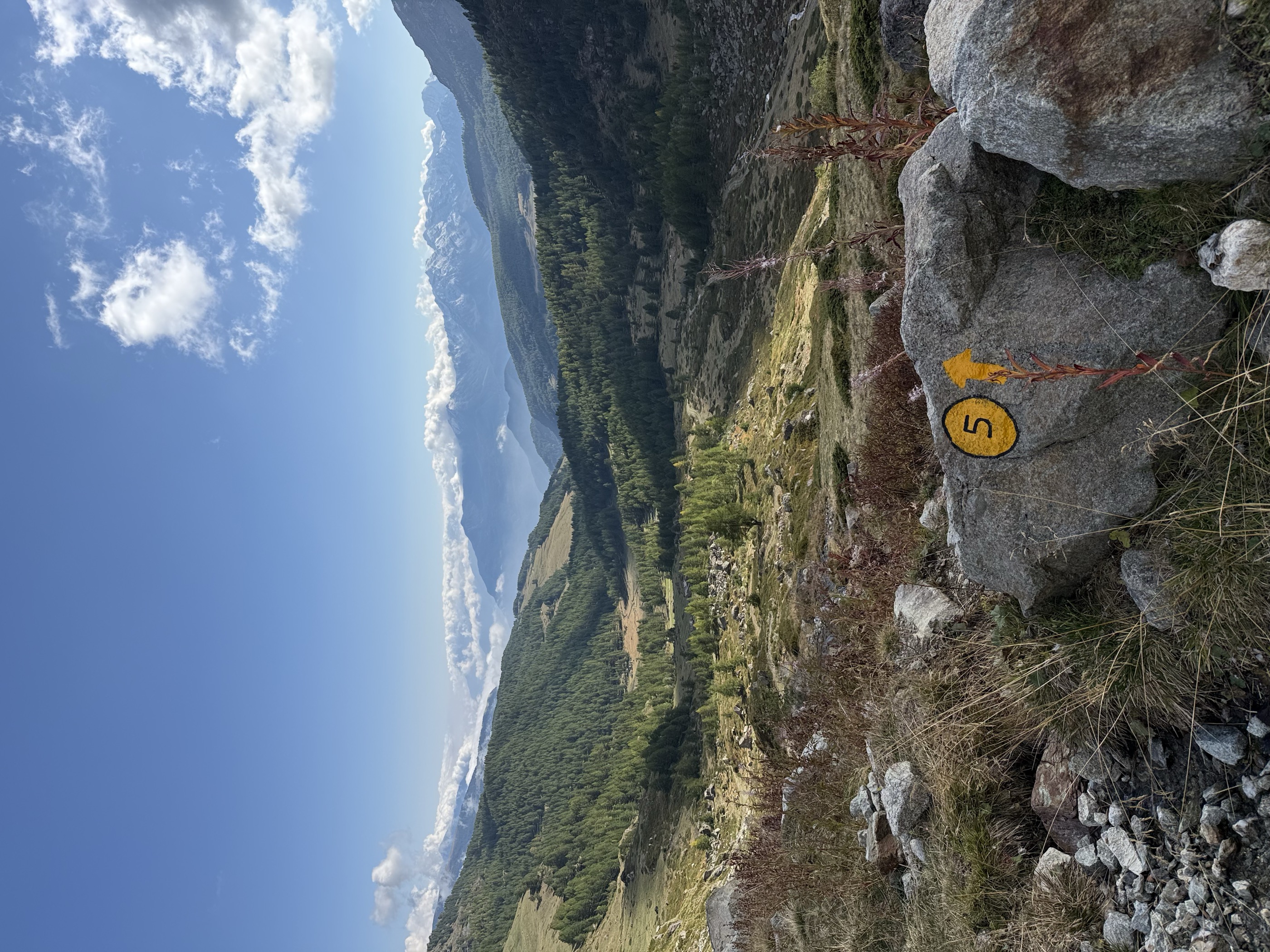
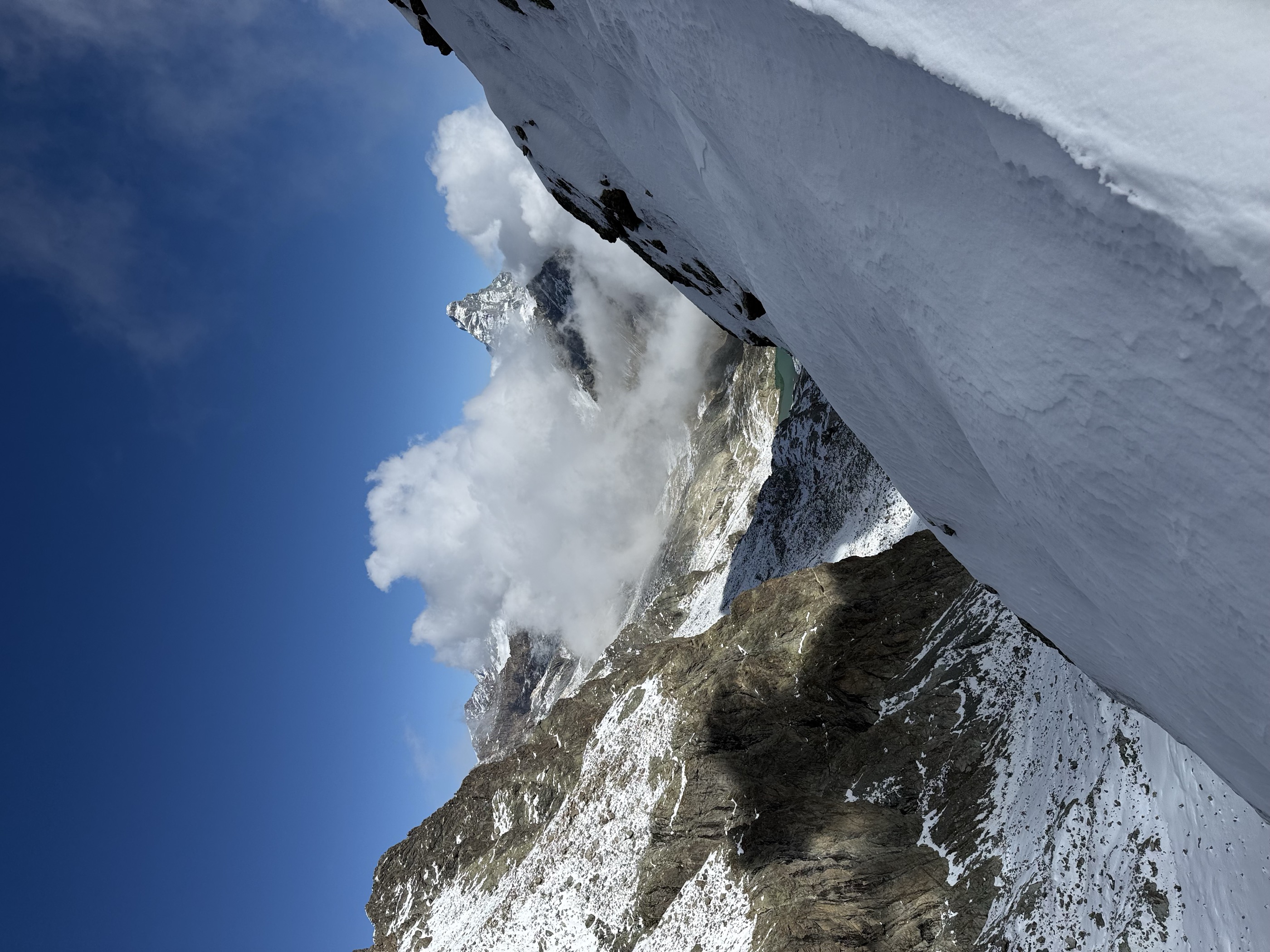
5. Saas Valley, Switzerland
Peak around 4 November (±6 days) at 1,920 m. Gold window: 31 October to 10 November. Last year: 24 October.
Saas-Fee, Saas-Grund and Saas-Almagell in the Pennine Alps, plus the Mattertal around Grächen and St. Niklaus; Zermatt, further up the valley, is outside this area. The Höhenweg from Grächen to Saas-Fee runs along the top of the larch forest. It is a long, exposed day, and the Hannigalp gondola above Grächen stops on 18 October. This area had the warmest September of all (13.1 °C at the larch), beyond anything our forecast has been tested on.
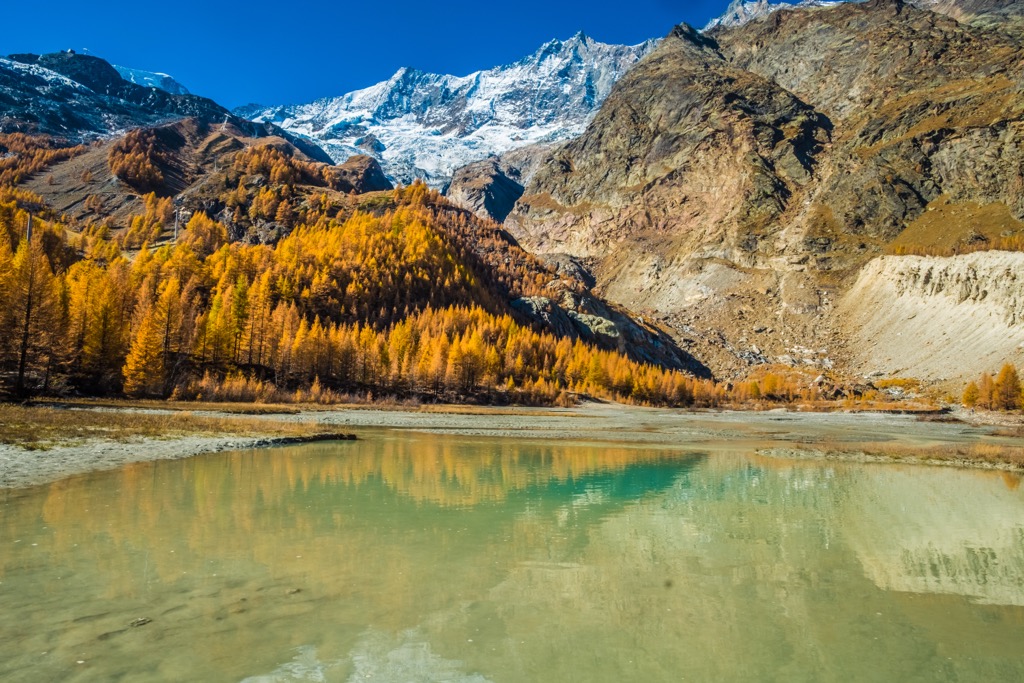
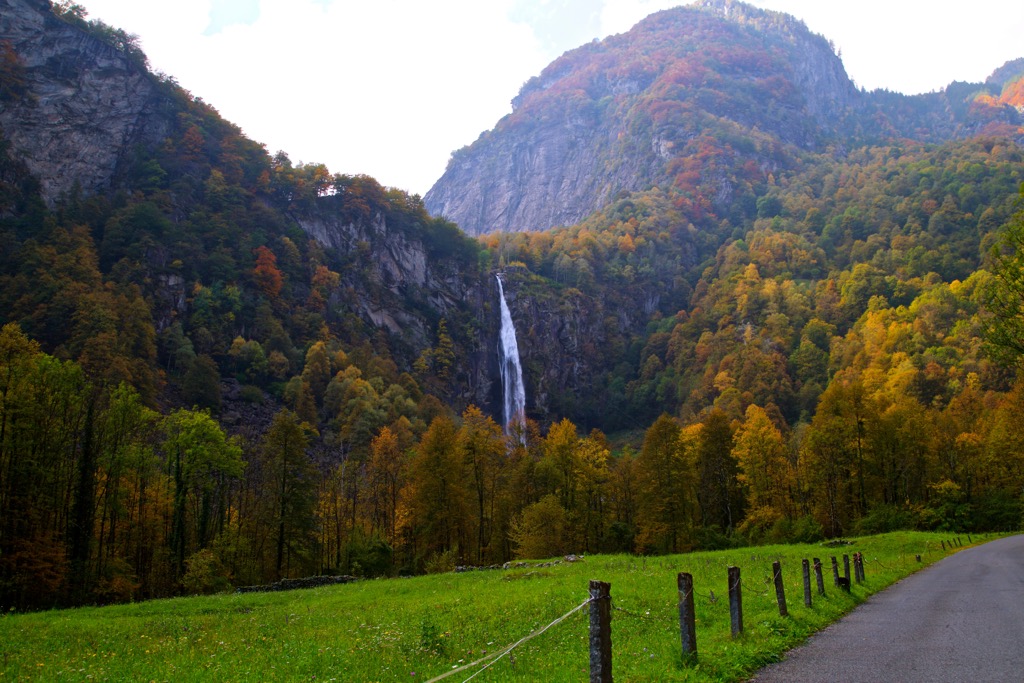
6. Valle Maggia & Formazza, Switzerland/Italy
Peak around 28 October (±4 days) at 1,770 m. Gold window: 24 October to 3 November. Last year: 18 October.
The earliest gold in the west, in the Lepontine Alps. Head for the Walser village of Bosco Gurin, the stone hamlets of the Val Bavona and, over the border, the Val Formazza. The Val Bavona bus runs until 31 October. Combine it with the Upper Engadin, which peaks a day earlier.
Central Alps: Engadin, Vinschgau and Val di Sole (Areas 7 to 9)
The central Alps split three ways: the Upper Engadin peaks with the first wave around 27 October, Upper Vinschgau four days later, and Val di Sole around 3 November, as late as the west.
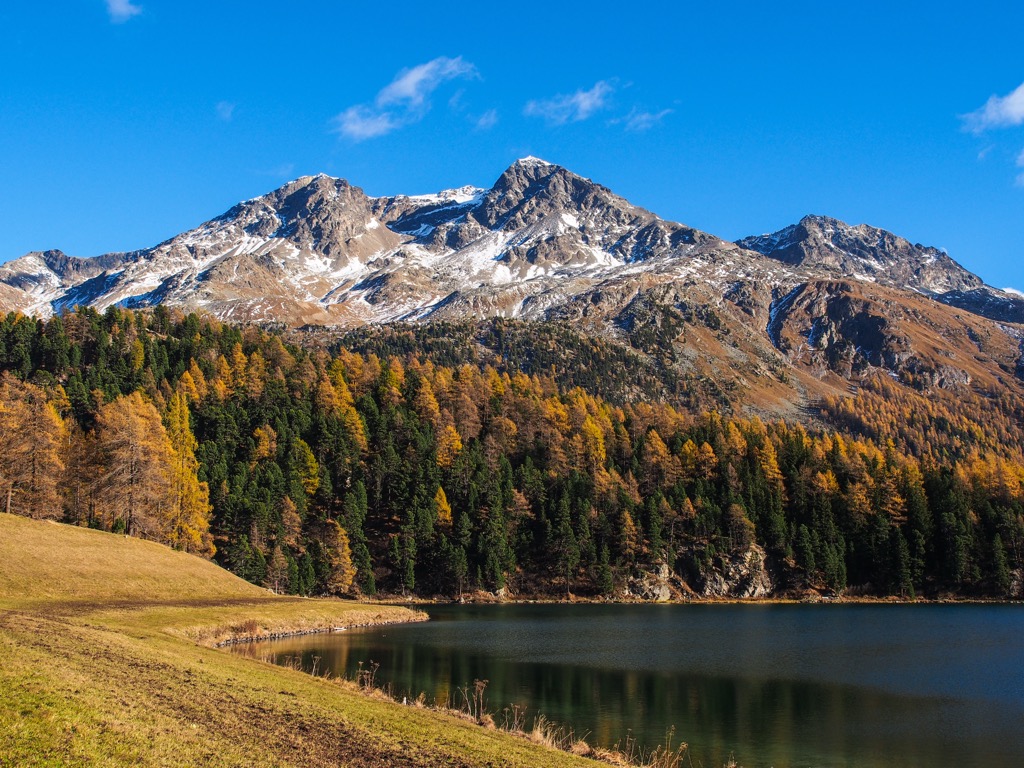
7. Upper Engadin, Switzerland
Peak around 27 October (±4 days) at 1,990 m. Gold window: 23 October to 2 November. Last year it peaked on 16 October.
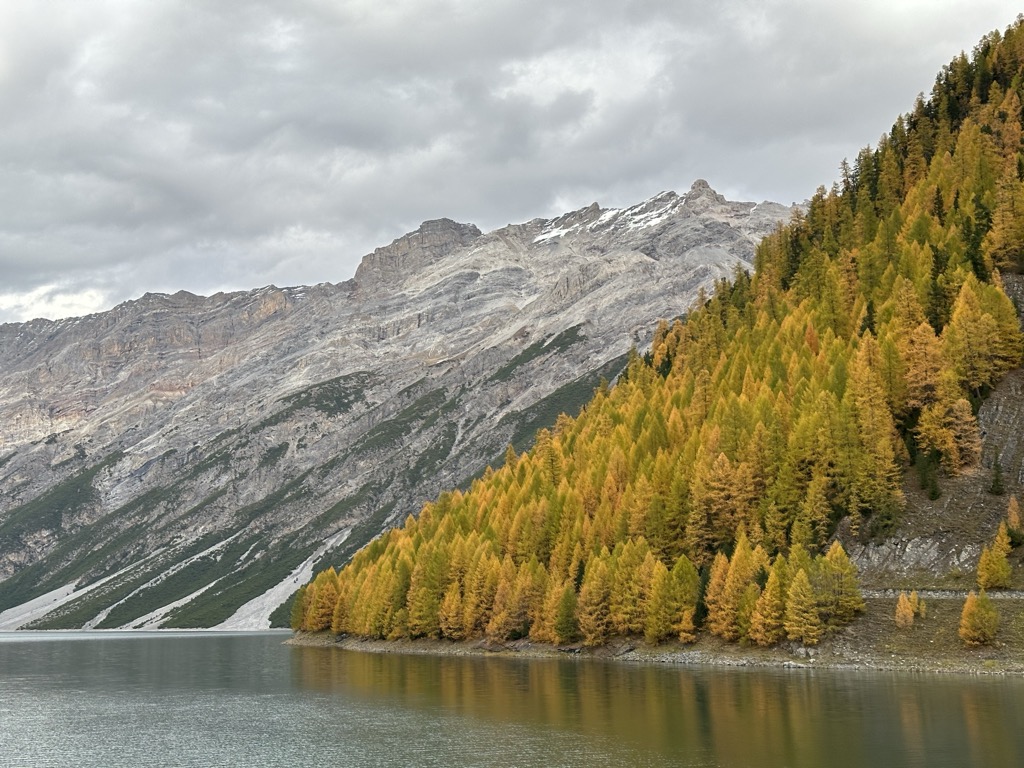
The classic larch valley north of the Bernina Range, with larch and stone pine around Pontresina, Samedan, Celerina, St. Moritz, Zuoz and La Punt. Walk into the car-free Val Roseg, or look down on the gold from Muottas Muragl; its funicular runs until 1 November. Val Trupchun in the Swiss National Park, reached from S-chanf, is known for its red deer, though most leave the park by mid-October. Across the Bernina, Livigno in Italy has the same gold on the slopes above its reservoir.
8. Upper Vinschgau, Italy
Peak around 31 October (±4 days) at 1,910 m. Gold window: 27 October to 6 November. Last year: 25 October.
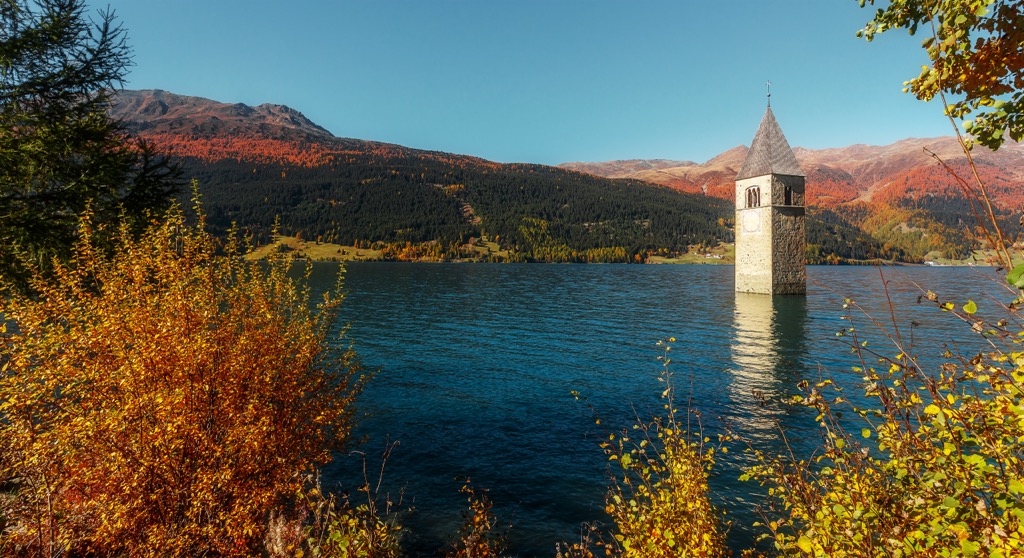
Larch woods above Mals, Glurns and Burgeis, in the Schlinig valley of the Sesvenna Range and the Matsch valley of the Ötztal Alps, and on the golden slopes behind the sunken church tower of Lake Reschen (Lago di Resia). Vinschgau is one of the driest valleys in the Alps, so the odds of a sunny day are good.
9. Val di Sole & Peio, Italy
Peak around 3 November (±4 days) at 1,930 m. Gold window: 30 October to 9 November. Last year: 1 November.
The Val di Peio above Cogolo and the Val di Rabbi, in Trentino's part of the Stelvio National Park, plus Vermiglio towards the Tonale Pass and the slopes up to Madonna di Campiglio below the Brenta. This corner turns later than its neighbours, in 2025 as now.
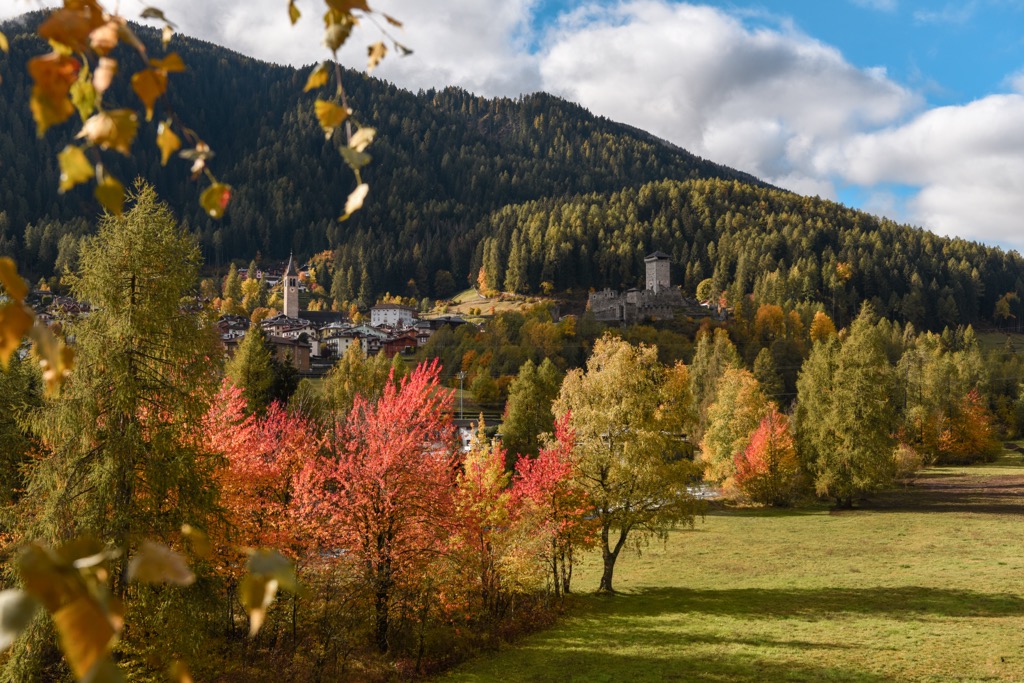
From Bavaria to the Dolomites and Carnia (Areas 10 to 16)
Bavaria opens the season, and the Dolomites follow. The Zugspitze and Wetterstein peak around 18 October, Wipptal on 26 October, Cortina & Alta Badia and the Mölltal on 27 October, Villgraten on 28 October, then Carnia and Val di Fiemme at the end of the month.
10. Val di Fiemme & Lagorai, Italy
Peak around 31 October (±4 days) at 1,830 m. Gold window: 27 October to 6 November. Last year it peaked on 24 October.
Larch above Cavalese, Tesero and Predazzo, and in the lake-studded Lagorai range of the Fiemme Mountains to the south. The slopes around the Alpe Cermis above Cavalese give wide views across the valley. Its lifts close in September, though, and reopen only for the ski season.
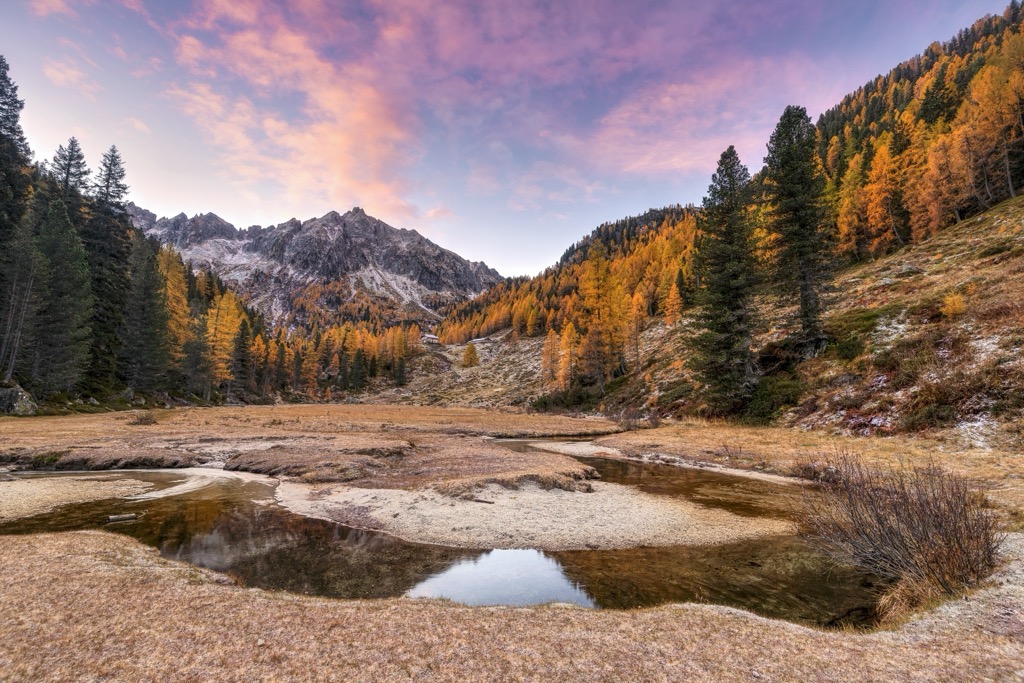
11. Wipptal & Pfitsch, Italy
Peak around 26 October (±3 days) at 1,830 m. Gold window: 22 October to 1 November. Last year: 19 October.
One of the earliest areas in our Italian forecast. Sterzing (Vipiteno) and the Pfitsch valley, which climbs into the Zillertal Alps up to the Austrian border. Over the ridge to the south-east, off the Pustertal, are the Pfunders valley and the Vals valley with the Fane Alm, a hamlet of old huts you walk up to through larch woods. One valley further east, Lappach in the Mühlwalder Tal is the same forest. Sterzing is 15 km from the Brenner Pass, which makes this the easiest Italian area to reach from the north.
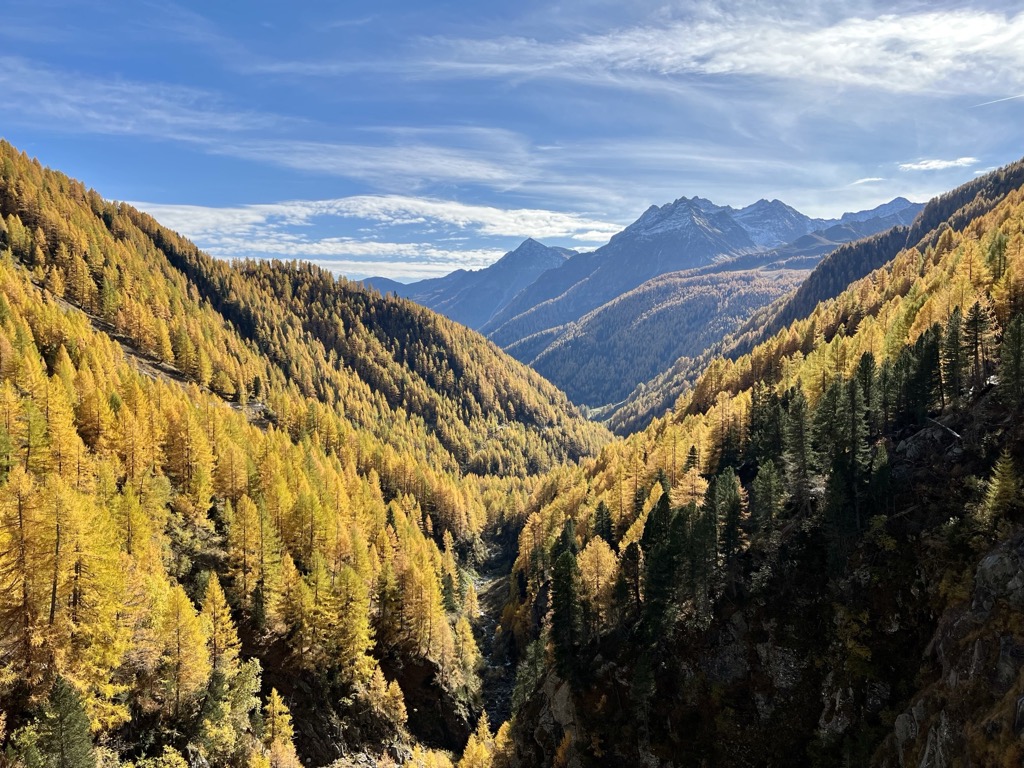
12. Cortina & Alta Badia, Italy
Peak around 27 October (±4 days) at 1,860 m. Gold window: 23 October to 2 November. Last year: 20 October.
This is where our webcams watch the larch. In the Ampezzo Dolomites it climbs to about 2,100 m near Col Gallina, below the Cinque Torri and the Lagazuoi. In Alta Badia it spreads over the Pralongià pastures and around Armentarola, next to the Fanes-Senes-Braies Nature Park. Passo Giau and Passo Falzarego are the classic roadside viewpoints.
On 4 October the webcams showed 2 to 24 % of the larch turned; the stands near 2,050 m should peak on 23 or 24 October. Most lifts here have closed by early October and the Lagazuoi cable car stops on 18 October, so plan to explore on foot and from the pass roads.
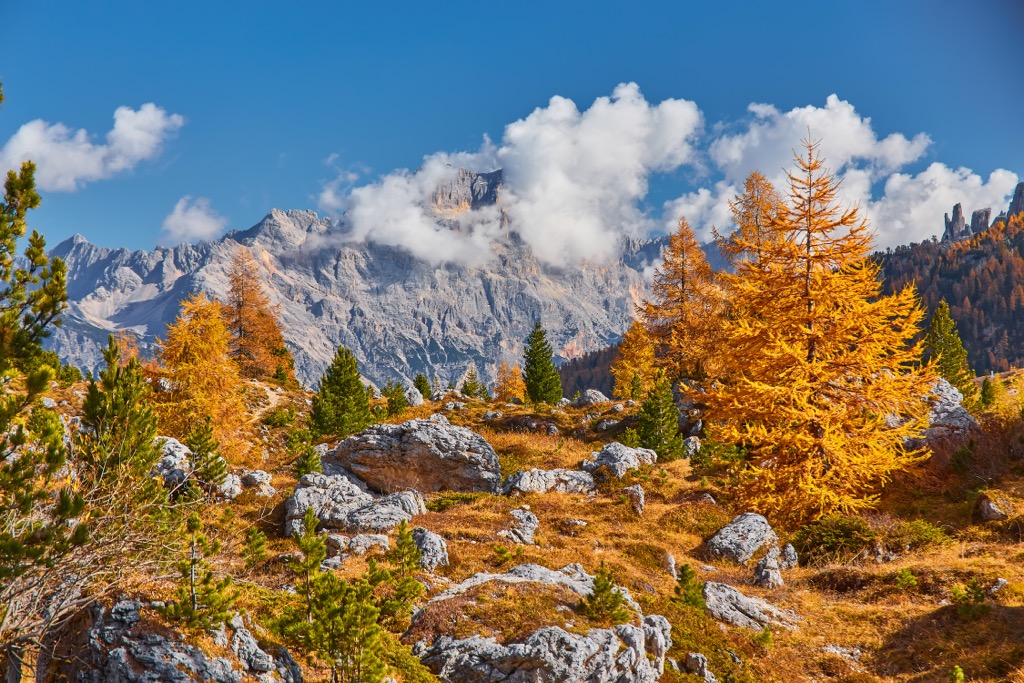
13. Villgraten, East Tyrol, Austria
Peak around 28 October (±4 days) at 1,830 m. Gold window: 24 October to 3 November. Last year: 24 October.
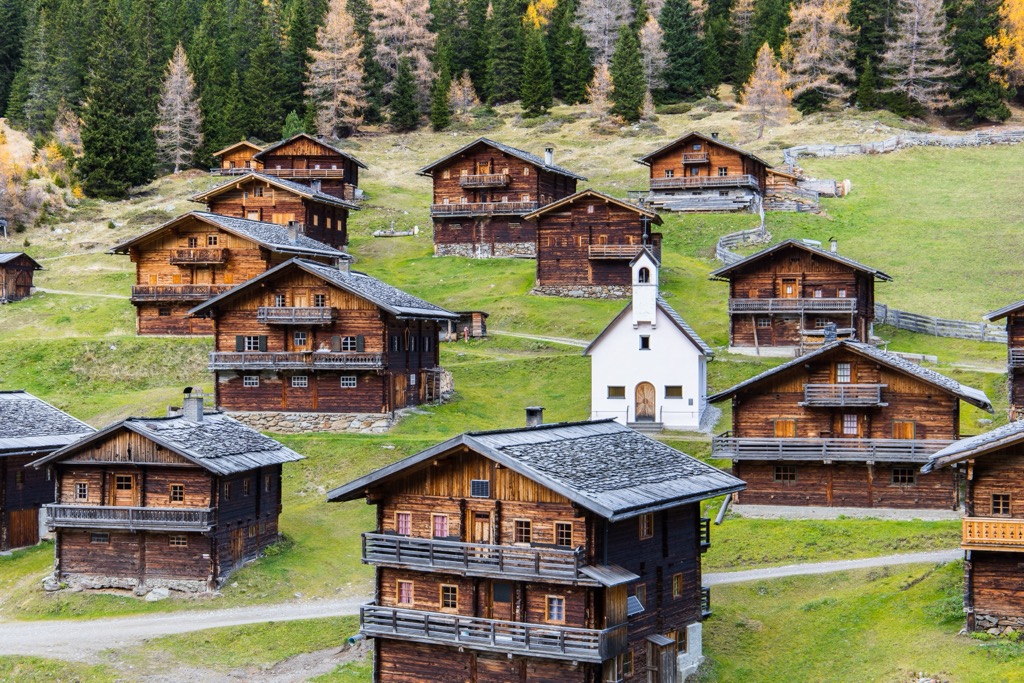
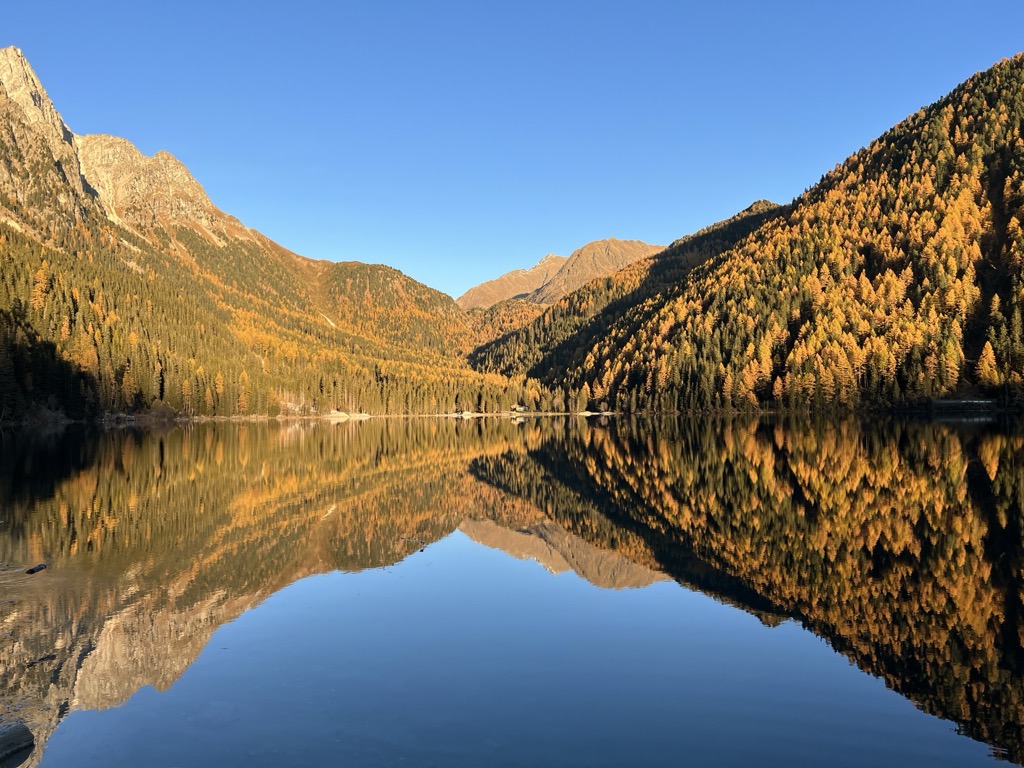
The quiet Villgraten valley in the Villgraten Mountains, with the villages of Innervillgraten and Außervillgraten. Sillian sits on the Drau below, and Kartitsch and Obertilliach lie south of the river, in the Carnic and Gailtal Alps towards the Lesachtal. Old farmsteads sit among larch meadows. On the Italian side of the same mountains, the Antholz valley and Lago di Anterselva carry the same larch. Cortina is about an hour's drive away, so the two pair well.
14. Carnia, Italy
Peak around 30 October (±4 days) at 1,700 m. Gold window: 26 October to 5 November. Last year: 30 October.
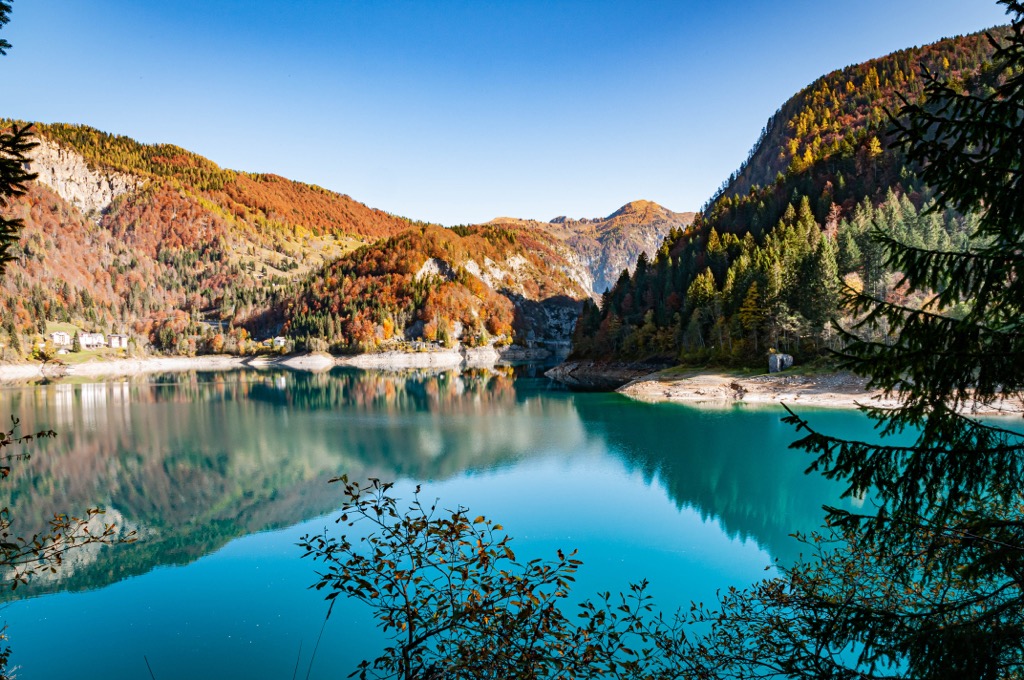
The Friulian Dolomites around Forni di Sopra and Forni di Sotto, and the road from the village of Ampezzo up to Sauris, with its old wood-and-stone houses above the lake. Carnia runs a few days behind Cortina and Alta Badia, which makes it a good second stop.
15. Zugspitze & Wetterstein, Germany/Austria
Peak around 18 October (±5 days) at 1,200 m. Gold window: 14 to 24 October. Last year a valley larch at Oberstdorf was half gold on 18 October.
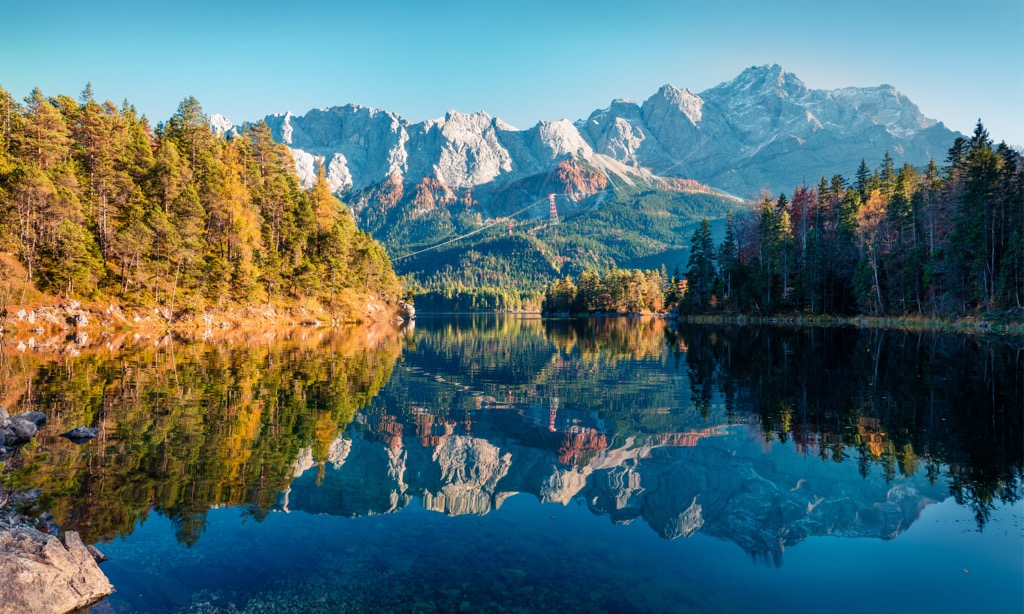
The northern side of the Wetterstein, around the Zugspitze. Above Mittenwald, walk to the Ferchensee, the Lautersee and the Kranzberg. Grainau and the Eibsee are the German roadside views. Across the border, Ehrwald and the Gaistal hold the same forest. Larch here grows lower than in the Dolomites, mixed with spruce.
This valley was not in the satellite set. The date uses the nearest official record and the same temperature rule as the other areas. At Oberstdorf, still in the northern limestone Alps, a German weather service observer recorded needles half gold on 18 October 2025, at 810 m. Above Mittenwald, 1 September to 5 October this year ran 2.0 °C warmer than in 2025, about four days of delay, which would put a tree at that valley height on 22 October. The larch we are dating sits near 1,200 m, about 400 m higher, and higher slopes turn a few days sooner. The two shifts meet around 18 October. The margin is five days because the 2025 date is one valley tree, not a satellite mean for this forest.
16. Mölltal, Austria
Peak around 27 October (±4 days) at 1,760 m. Gold window: 23 October to 2 November. Last year: 24 October.
A southern gateway to the Hohe Tauern: Obervellach, Flattach and Mallnitz, at the mouth of the Seebachtal. Larch lines the valley walls from about 1,400 to 2,000 m. The Nockberge, further east, peaks a day earlier.
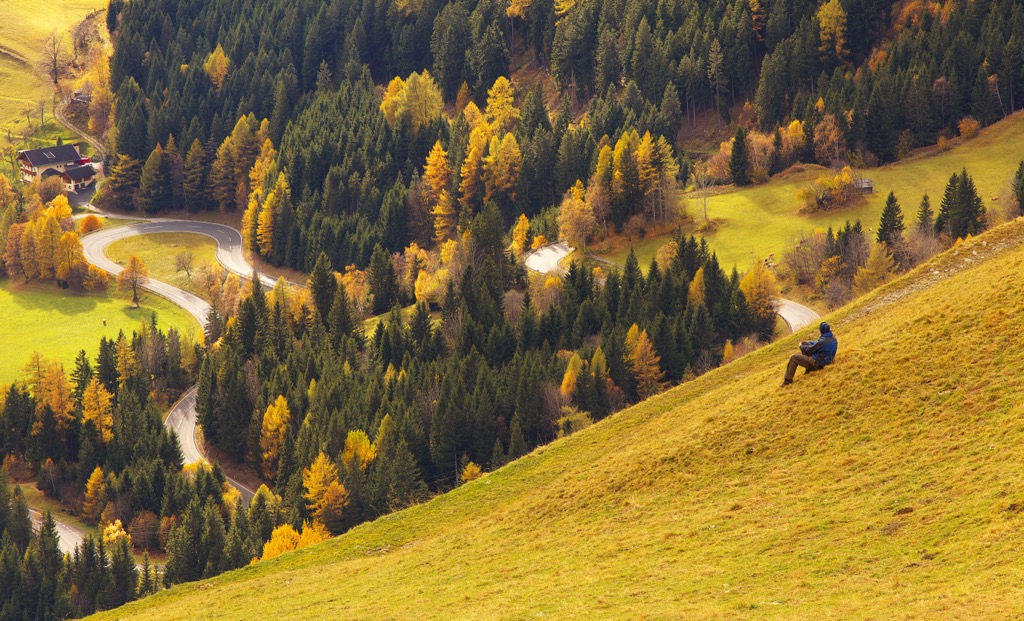
Eastern Alps: Nockberge to the Julian Alps (Areas 17 to 20)
The Eastern Alps open the season alongside the Dolomites: the Nockberge peaks around 26 October and the Sölk valleys around 27 October. The Julian Alps follow around 30 October, and Hochschwab, where the larch grows lower, around 3 November.
17. Nockberge & Turracher Höhe, Austria
Peak around 26 October (±4 days) at 1,780 m. Gold window: 22 October to 1 November. Last year it peaked on 20 October.
Rounded, grassy-topped mountains of the Gurktal Alps, with larch and stone pine on their slopes: one of the largest larch areas in this guide, about 66 km². The lake on the Turracher Höhe pass is ringed by larch and stone pine. The Nockalmstraße crosses the Nockberge Biosphere Reserve; it is a seasonal toll road, open until the end of October.
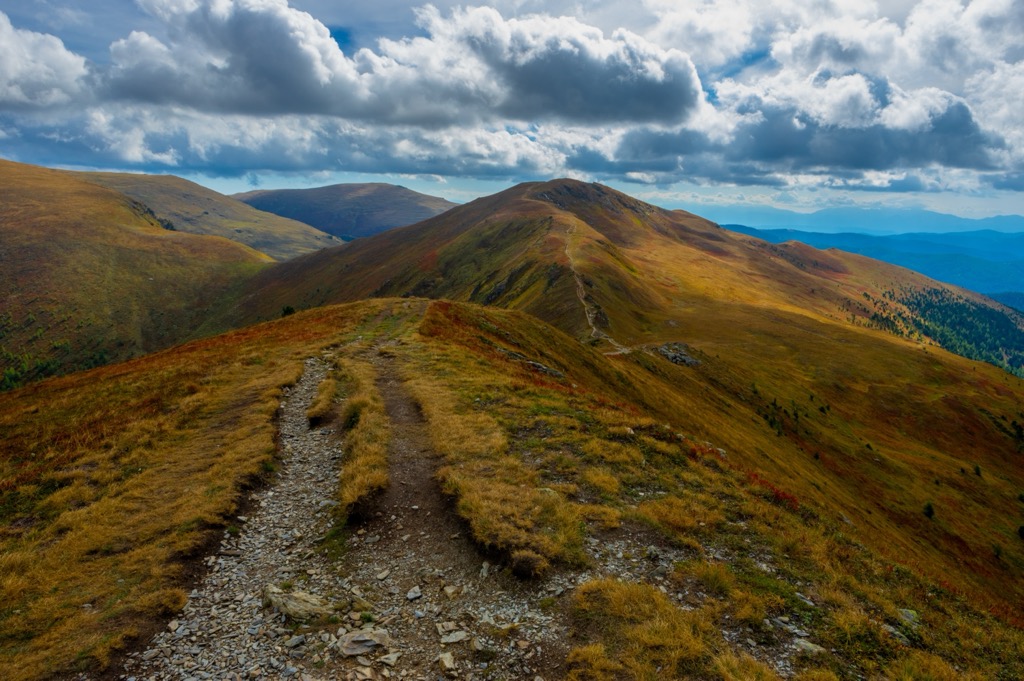
18. Julian Alps, Slovenia
Peak around 30 October (±5 days) at 1,620 m. Gold window: 26 October to 5 November. Clouds hid it from the satellite in 2025.
Kranjska Gora is the base for the Julian Alps. The Vršič Pass road crosses Triglav National Park to the Trenta valley and the source of the Soča. Near town are the Planica valley and the Zelenci springs. Without a clear view last autumn, this date leans on the Alps-wide pattern, so treat it as a best estimate.
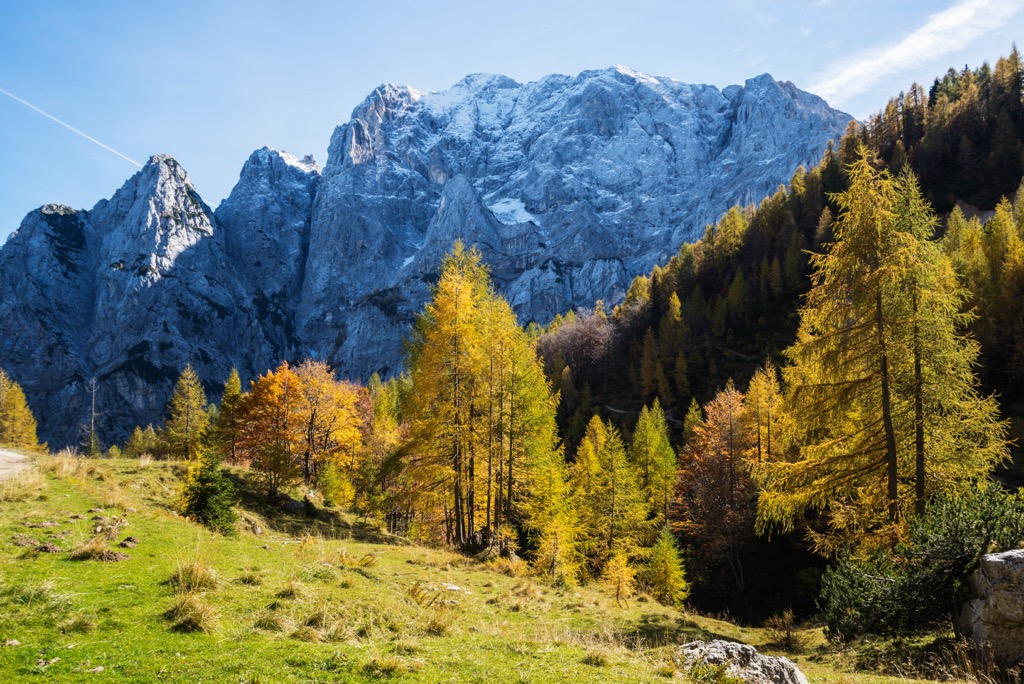
19. Sölk Valleys, Austria
Peak around 27 October (±4 days) at 1,670 m. Gold window: 23 October to 2 November. Last year: 20 October.
The Sölktäler Nature Park, where the Schladming Tauern meet the Wölz Tauern: the Großsölk and Kleinsölk valleys, the Schwarzensee, and the Sölkpass road between the Enns and Mur valleys. In 2025 the upper and lower slopes here turned within a day or two of each other, so there is little to gain by waiting.
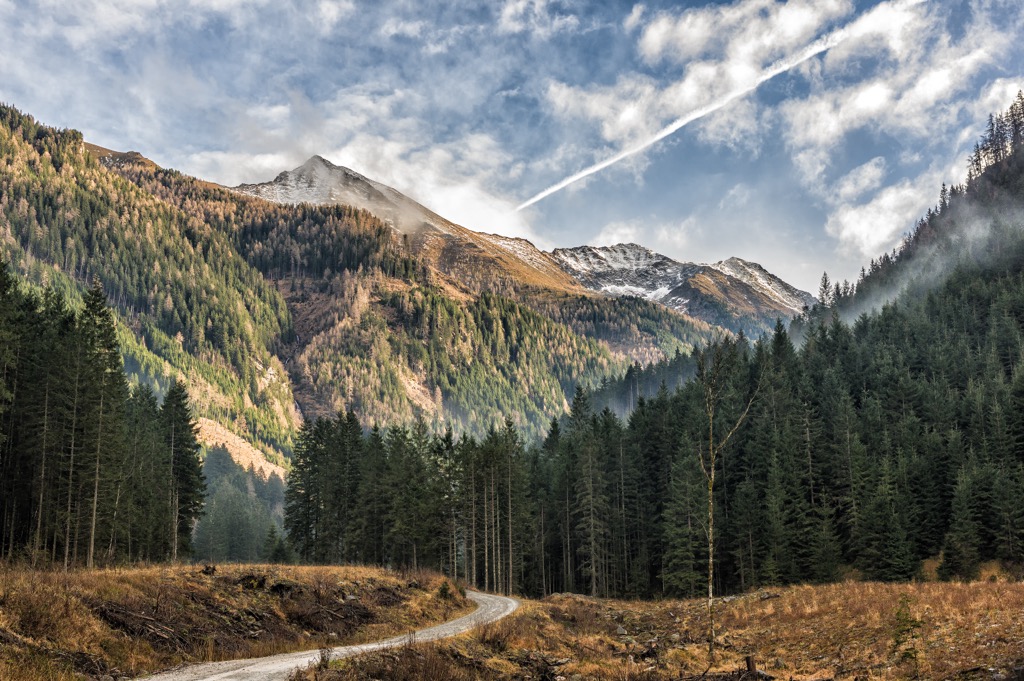
20. Hochschwab & Mariazell, Austria
Peak around 3 November (±6 days) at 1,280 m. Gold window: 30 October to 9 November. Clouds hid it from the satellite in 2025.
Here the larch grows low, mixed with spruce and beech, around the pilgrimage town of Mariazell, the Erlaufsee and the northern flank of the Hochschwab. Lower forests turn later, so this is the late option in the east. The date leans on the Alps-wide pattern, hence the wider margin.
How to Time Your Trip and Catch the Best Light
Aim for the peak, but plan for the window: our dates carry 3 to 6 days of uncertainty, and each stand holds its gold for about 10 days.
- Go up if you are early, down if you are late. Slopes 200 m above an area's peak height turn a few days sooner; valley floors a few days later.
- Follow the sun. The late-October sun is low, so south- and east-facing slopes glow while narrow north-facing valleys can stay in shade all day. Panorama 3D shows when the Sun clears the ridge from your viewpoint.
- Shoot backlit larch in the morning and late afternoon. Overcast days suit forest close-ups: the colour reads evenly, without hard shadows.
- Find a still lake at dawn for reflections: Lac Miroir above Ceillac, Lake Reschen, the Turracher See, and the Lac d'Allos (a long walk in once its road closes for winter).
- Watch the weather, not just the date. A dusting of snow above golden larch is the classic shot, but a föhn storm or heavy snow can strip the needles in a day.
- Check roads and lifts. High roads such as the Col de la Cayolle, the Vršič and Sölk passes and the Nockalmstraße close for winter, some with the first heavy snow, and many lifts close between summer and winter.
Plan the trip in PeakVisor. Scout the larch slopes in 3D before you go, switch on the Aspect layer to find the ones facing the sun, plan your route, and download offline maps for valleys without signal. All of it is part of PeakVisor PRO.
Looking for more autumn ideas? Read An Ode to Autumn, our guide to Europe's fall colours.
Golden Larch FAQ
When do the larches turn gold in the Alps in 2026?
Between about 14 October and 13 November. Peak gold at the main larch height runs from 18 October around the Zugspitze to 7 November in the Aosta Valley and the upper Susa Valley.
Where are the best golden larch forests in the Alps?
The largest larch areas we mapped are the upper Susa Valley and Montgenèvre (about 98 km²), the Nockberge, Upper Vinschgau, Villgraten and the Dolomites around Cortina. The Upper Engadin and the Saas valley are the classic Swiss choices.
Why is the larch season late in 2026?
September was unusually warm. At larch height, 1 September to 5 October averaged 1 to 5 °C more than in 2025. Our model estimates a delay in peak colour of about two days for each additional degree over that period.
How long do larches stay golden?
A single stand holds its gold for about 10 days, from roughly four days before its peak to six days after. A whole valley lasts longer, because higher slopes turn first and valley floors last. Across the Alps the season spans about four weeks.
Do larches really lose their needles?
Yes. The European larch (Larix decidua) is the only conifer in the Alps that sheds its needles: they turn yellow and gold each autumn, then fall. In the Alps it grows mostly from about 1,000 m up to the treeline at 2,000 to 2,500 m, often with stone pine and spruce.
Is late October or early November better for golden larches?
In 2026, mid-October around the Zugspitze, late October for the eastern Alps and the Dolomites, early November for the west. In the cooler autumns of 2024 and 2025 the peak came one to two weeks earlier.
What can end the golden season early?
Strong föhn winds or the first heavy snow. Either can strip the needles within a day, so check the mountain forecast before you travel.
How accurate is this forecast?
Our margin is 3 to 6 days. In the Dolomites, satellite and webcams put the 2025 turn within two days of each other. The western areas are the least certain: September 2026 there was warmer than any season we have tested.
How We Forecast the Larch Gold
The forecast rests on three autumns of satellite images, our own webcams and the weather record.
- Where the larch grows. We read every clear Sentinel-2 image of the Alps from late August to late November in 2023, 2024 and 2025, at about 100 m resolution. We counted as larch any forest mapped as needle-leaved that loses its green by November. That gives about 2,840 km² of larch-dominated forest.
- When it turned. In each image we compared the larch with the evergreen forest around it to reduce the influence of haze and light snow, and dated its turn to gold. At our three Dolomites webcams, satellite and webcams agreed within two days, and the peak followed the turn by about a week.
- When it will peak in 2026. Our model estimates a delay in peak colour of about 2.1 days for each additional degree in the 1 September to 5 October mean at larch height. We measured that relationship on our webcams over four autumns and found the same rate across the Alps in the satellite years. Each area keeps its own offset from the model's temperature relationship.
Data: Copernicus Sentinel-2 imagery (AWS Open Data), ESA WorldCover 2021, the Copernicus CLC+ Backbone 2021, ERA5 weather via Open-Meteo, and PeakVisor terrain.