
 Expedition
On 11 June 1906, high in the Ruwenzori mountains of central Africa, Vittorio Sella and his companions stood on a summit wrapped in cloud. They had carried a large camera up the mountain, and now there was nothing to photograph. The expedition's chronicler, Filippo De Filippi, described what happened next:
They set up the photographic camera on its tripod, and, huddling around it, waited patiently. By two in the afternoon Sella gave it up, folded up the camera, and was on the point of leaving the peak, when suddenly the sky began to clear. … The camera was immediately set up again and a panorama taken.
A phone lets you take dozens of frames without thinking about the weight of each one. Sella's glass plates had to be carried up the mountain on someone's back. A day's work could be lost to damp or breakage, and a cloud could mean hours of waiting in the cold. He made some of the most admired mountain photographs ever taken. Decades later, climbers were still studying routes on them.
A Family Darkroom in Biella
Sella was born in 1859 in Biella, a wool town at the foot of the Alps north-east of Turin. He came from a family of mill owners. His uncle, the statesman Quintino Sella, founded the Club Alpino Italiano in 1863. His father, Giuseppe Venanzio Sella, ran the mill but was also a photography pioneer, and in 1856 he wrote the first treatise on photography published in Italy. When his father died in 1876, Vittorio inherited his laboratory and his manual.
In 1879 he borrowed a large camera from a Biella photographer and climbed Monte Mars, the highest of the mountains above Oropa. From its summit he made his first circular panorama of the Alps. He used the wet collodion process, which meant coating each glass plate with chemicals on the spot and developing it before it dried. Within a few years he had moved to factory-made dry plates. In 1882 he ordered a camera from Dallmeyer of London for glass plates 30 by 40 centimetres, roughly the size of a sheet of A3 paper. In a letter to the maker, as later quoted in English, he wrote that he burned “with impatience to start photographic excursions”.
Winter on the Matterhorn
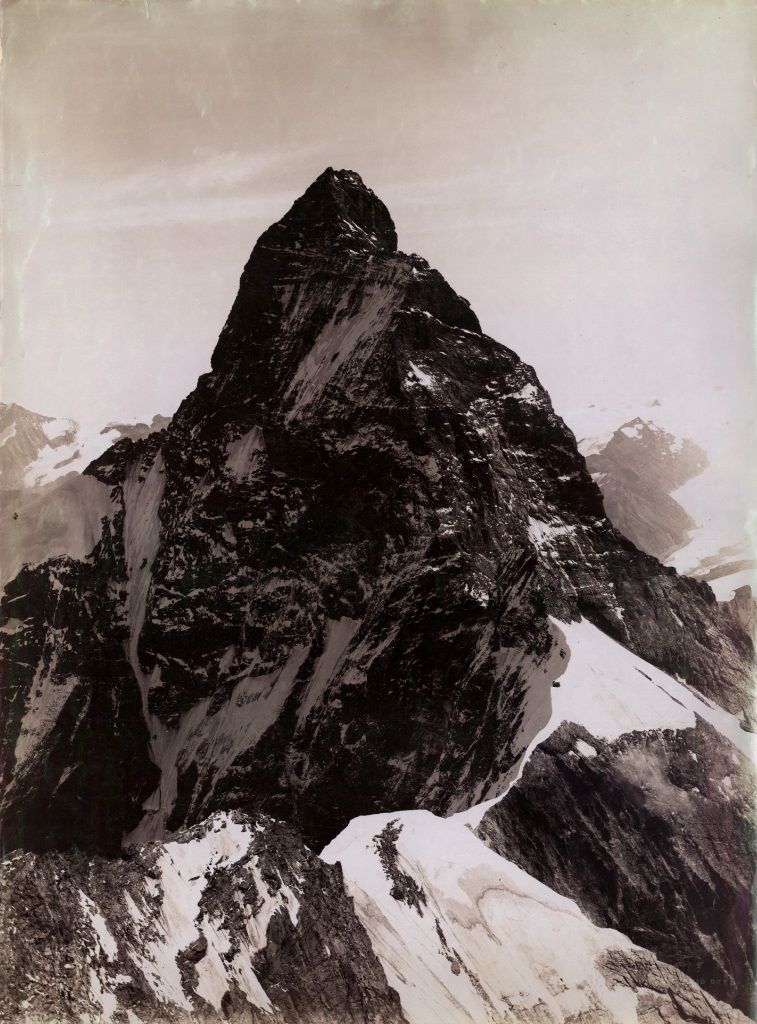
Sella's reputation began with a climb. In February 1882 he tried the Matterhorn twice in winter and failed. On the second attempt the party walked for twenty-three hours almost without stopping, and the “generous Barolo” in his leather flask froze into granita. They left Breuil again at 11 p.m. on 16 March with three guides of the Carrel family, and reached the summit at two the next afternoon. It was the first winter ascent of the mountain. Sella's own account of the top is unguarded: “Ours was an indescribable emotion, almost sacred, to which was added the sweet satisfaction of success.”
They came down the Swiss side, and so made the first winter traverse too. They spent the night in the snow-filled hut, pressed together on the frozen floor and stamping their feet so they would not freeze. Back home, Sella explained why anyone would climb in winter. Anyone who had seen the mountains then, he wrote, knew how “the great cold purifies the air”, sharpening colours and contrasts across the whole panorama. It was a photographer's argument. On 29 July 1882 he went back to the summit and photographed the full horizon on eleven glass plates.
The Weight of a Picture
A good photograph meant carrying the whole studio. By one curator's estimate, the big camera weighed about forty pounds, and each glass negative about two. Every exposure also needed a dark place to load and unload the plates. On expeditions Sella travelled with a black tent for changing negatives and a pocket red lantern. The Sella family designed its own load-carriers for mountain portage. When porters in the Karakoram at first refused the shoulder straps, Sella talked a number of them round.
He almost never worked alone. For years his assistant was Erminio Botta, another man from Biella. On the 1909 expedition De Filippi called him “at once assistant-photographer, guide and porter”. Sella also left camp early and on his own schedule. De Filippi describes him leaving before breakfast with Botta and the porters carrying the cameras, giving him more time to photograph along the way.


Alaska: The Picture That Failed
The great expeditions came in the 1890s. Sella photographed the Caucasus three times, and in 1897 he joined the young Duke of the Abruzzi on an attempt on Mount Saint Elias, on the border of Alaska and Canada. The whole party reached the summit on 31 July, the first ascent of the mountain. As photography, though, the trip went badly. The expedition book contains an equipment list drawn up from Sella's own notes. It records the big 30 by 40 camera and five dozen plates, and then adds one dry sentence: “This camera was only used to take one photograph.”
Most of the best pictures, Sella noted, came from a folding Kodak. The coastal damp got into his films, and many negatives were spoiled. His Italian biographer calls Alaska the most painful disappointment of his career. The images that survived still show the scale of the place. The expedition hauls its sledges across the Malaspina Glacier, the mountain far beyond.

 On the map Mount Saint Elias →
Two years later he went round Kangchenjunga with the British explorer Douglas Freshfield. Heavy snow buried their camp, but at about 20,000 feet the Sella brothers stopped to take photographs, among the highest anyone had made. Freshfield reported that they “proved perfectly successful”. In his preface he thanked Sella for almost all of the book's illustrations.
K2, 1909
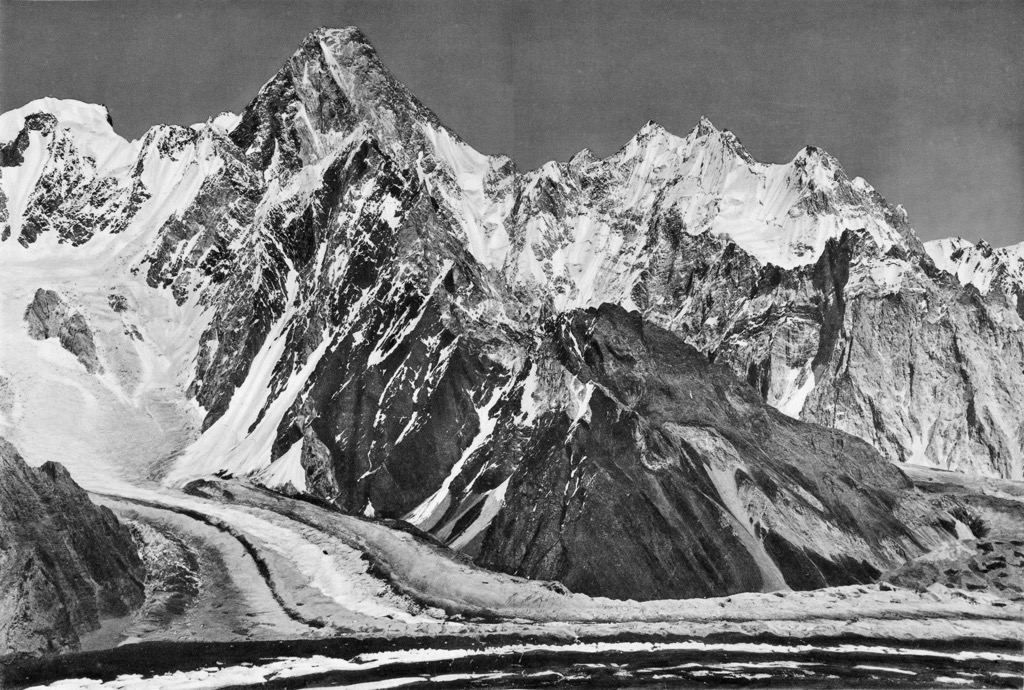
The expedition that made Sella's name in the Himalaya went to the Karakoram in 1909, again with the Duke of the Abruzzi. The aim was K2, the second-highest mountain on Earth. The party worked its way up the Baltoro and Godwin-Austen glaciers. They tried the mountain's south-east ridge, and then set an altitude record on Chogolisa without reaching its summit. Sella and Botta spent long days apart from the others, climbing to camera stations and waiting for the weather. At Windy Gap, at the head of the Godwin-Austen Glacier, De Filippi and the topographer Negrotto set up their survey camera on one side of the col while Sella waited with his on the other. De Filippi remembered them:
all three of us waiting in a cutting wind, our teeth chattering, stamping our feet and slapping our hands together, indulging the vain hope that the sky might clear.
The photographs Sella brought back were more than beautiful. They were accurate. He built cairns to mark his camera stations so that the surveyors could tie each panorama into the expedition's map. In 1938 an American party under Charles Houston went to reconnoitre K2. Houston's report was published the following year. It printed a 1909 Sella photograph of the ridge the Duke had tried, with the Americans' proposed route drawn on it. It was Houston's party that christened it the Abruzzi ridge. “Vittorio Sella brought back hundreds of mountain photographs which have yet to be equalled,” he wrote.
 On the map K2 and the Godwin-Austen Glacier →
“No Faked Grandeur”
In 1946, three years after Sella's death, Ansel Adams wrote about an exhibition of his prints for the Sierra Club Bulletin. Adams, already one of America's leading landscape photographers, did not praise lightly:
The vastness of the subjects and the purity of Sella's interpretations move the spectator to a definitely religious awe.
What struck Adams was restraint. He saw no theatrical skies or exaggerated angles. “In Sella's photographs there is no faked grandeur,” he wrote; instead there was “understatement, caution, and truthful purpose.” His admiration does not mean that the prints were untouched. According to the curator Paul Kallmes, Sella sometimes added figures to a picture in the darkroom to give the viewer a sense of scale.
Ten Thousand Negatives
Sella kept climbing into old age. At seventy-six he set out for the Matterhorn once more, and turned back when one of his guides was hurt. He died at home in Biella in 1943. His work is still there. The Fondazione Sella, housed in the family's old wool mill, keeps about ten thousand of his negatives and some twelve thousand prints, along with the big glass plates and some of the equipment. It is a research archive, not a museum, and visits are by appointment.
On the map Fondazione Sella, Biella →On that summit in the Ruwenzori, Sella had folded up the camera at two in the afternoon and was about to leave. Then the cloud lifted, and he unpacked everything and began again.
Sources and Further Reading
- Fondazione Sella, Biella — Vittorio Sella: biography, archive and photographic fund
- P. Crivellaro, “Sella, Vittorio” — Dizionario Biografico degli Italiani, Treccani (2018)
- Vittorio Sella, Ascensione invernale del Cervino (1882), his own account of the winter ascent
- Filippo De Filippi, The Ascent of Mount St. Elias (1900) — Internet Archive
- Filippo De Filippi, Ruwenzori (1908) — Internet Archive
- Filippo De Filippi, Karakoram and Western Himalaya 1909 (1912) — Internet Archive
- Douglas Freshfield, Round Kangchenjunga (1903) — Internet Archive
- Charles Houston, “A Reconnaissance of K2, 1938” — Himalayan Journal 11
- Ansel Adams, “Vittorio Sella: His Photography” — Sierra Club Bulletin, December 1946
- Mark Haworth-Booth, “The Return of Vittorio Sella” — Alpine Journal 2009