
 Spiritual
In the winter of 1937, Ludwig Wittgenstein waited for the sun. His small wooden house stood on a ledge above Lake Eidsvatnet in western Norway, under a mountainside so steep that for weeks in midwinter the sun never cleared the ridge. On 8 March he wrote in his diary that he longed to see the sun from his house, and that every day he estimated how many more days it would stay away. On 22 March it came: “Today the sun rises here at 12 o'clock and now appears in full.” He noticed the first fly of the year on the outside of his window, where the light fell. Two days later he watched the sun set at about half past one and then run along the rim of the mountain, so that its edge stayed visible for a long time. “It is glorious!” he wrote. “So it has not really set after all.”
Wittgenstein came here to work, but his diary also records the weather, the lake ice and the light at his window. Other mountain rooms held different routines: Mahler composed in the mornings and walked in the afternoons; Næss returned to the same hut for decades. Their letters and recollections describe both the work and the daily life around it.
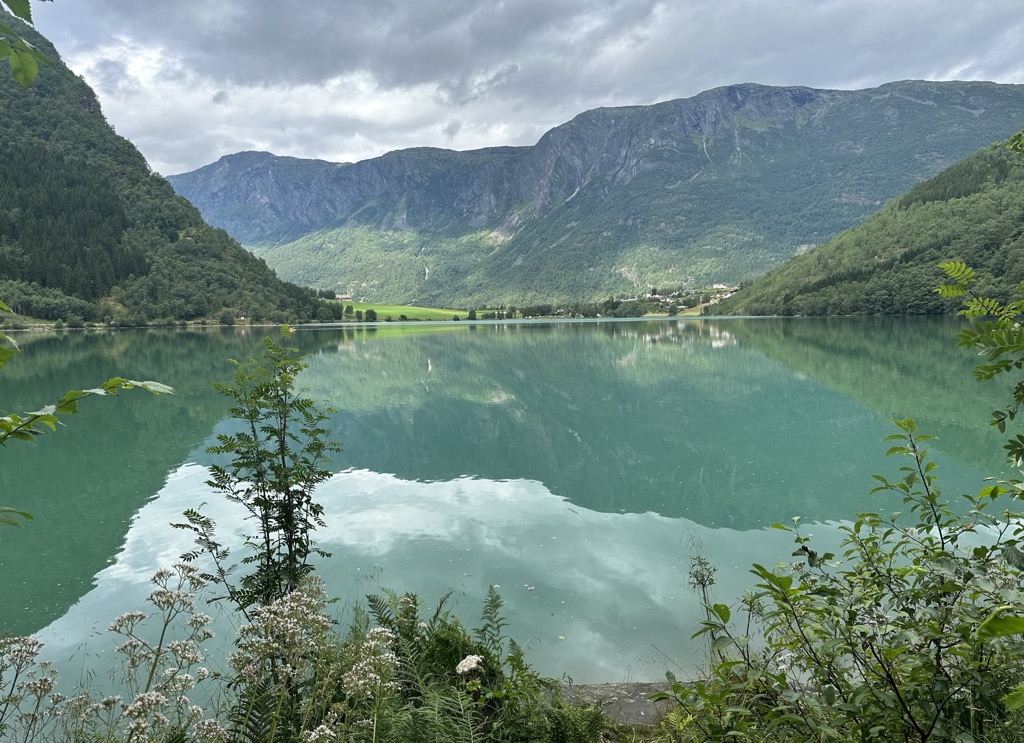
Wittgenstein: A House Called “Austria”
Wittgenstein first came to Skjolden, at the inner end of the Sognefjord, in October 1913. He was twenty-four, a former engineering student who had abandoned Manchester for Cambridge and Bertrand Russell's logic. Now he wanted to get away from Cambridge too. He rented two rooms in the postmaster's house, and wrote to Russell in English:
This is an ideal place to work in. […] As I hardly meet a soul in this place, the progress of my Norwegian is exceedingly slow; so much so that I have not yet learned a single swear-word.
He enclosed a rose leaf “as sample of the flora”. Within months he had designed a house of his own on the far side of the lake, and the building materials were taken across the ice that winter. Locals called the place Østerrike, “Austria”, after its owner. The house was finished in 1914, after he had gone back to Austria, where the war soon overtook him. He did not live in it until 1921.

His longest stay began on 27 August 1936. He was forty-seven, famous and dissatisfied, and he had come to make a fresh start. Over the following year, with breaks in Vienna and England, he began the first version of what became the Philosophical Investigations. He explained the arrangement to G. E. Moore with a sketch map. The mountain behind the house was “much too steep for anyone to walk on it along the lake”, so he could not get to the village without rowing:
I do believe that it was the right thing for me to come here thank God. I can't imagine that I could have worked anywhere as I do here. It's the quiet and, perhaps, the wonderful scenery; I mean, its quiet seriousness.
The solitude was not an idyll. He did all his own housework, “and it takes a good deal of time. But that's good too.” His diary that winter is full of self-reproach and confession. One day he thanked God that he had come to Norway, into solitude. Another day he warned himself that being alone was no protection: “There is no one here” — but one can go mad alone, too. In April the ice turned rotten, and he had to cross the river by boat, with what he called inconveniences and slight dangers.
In 1958, seven years after his death, the house was taken down and rebuilt in the village with a new entrance and the roof turned round. In 2017–18 a local foundation dismantled it again and put it back on its original stone foundation, and in 2019 the house was reopened. You can walk to it from Vassbakken, three kilometres from Skjolden. The path crosses farmland and ends in a steep rocky section with metal rods drilled into the rock. Between April and October you can rent the key for an hour at the campsite or the village shop, and sit inside.

 On the map Wittgenstein's house above Eidsvatnet →
Heidegger: The Hut at Todtnauberg
Martin Heidegger's hut stands on a steep meadow above the hamlet of Rütte, near Todtnauberg in the southern Black Forest, at about 1,150 metres. It was built in 1922. His wife Elfride chose the plot and paid for it with an advance on her inheritance. Heidegger described it as a small ski hut of six by seven metres, with three rooms under a low roof: a kitchen-living room, a bedroom and a study cell. He used it for the rest of his life. Parts of Being and Time were written at Todtnauberg, and the book's dedication is dated there, in April 1926.
In 1933 he turned down a chair in Berlin, and in a radio text explained why he stayed in the provinces. He wrote that deep winter nights, when a snowstorm raged around the hut, were the high time for philosophy. In the same text he wrote: “Ich selbst betrachte eigentlich die Landschaft gar nie.” (“I myself never actually look at the landscape.”) For Heidegger, the mountain was not something to look at. It was the setting his work happened in.
The same year, Heidegger joined the Nazi Party. He remained a member until 1945, and served for a year as rector of Freiburg University under the new regime. His private notebooks from those years, the so-called Black Notebooks, were published from 2014 and contain antisemitic passages. The hut is private and still owned by the family. You can see it from the Martin-Heidegger-Rundweg, a 6.2-kilometre loop with information boards, but the hut itself is not open to visitors.

Celan: A Word to Come
For the poet Paul Celan, a visit to the hut raised a question that went far beyond the appeal of a quiet place to work. On 24 July 1967 he gave a reading in Freiburg to a packed lecture hall, with Heidegger in the audience. Celan was a German speaker from Czernowitz. His parents had been murdered during the Holocaust, and he had survived a forced-labour camp. He admired Heidegger's thought and knew his past. Before the reading he at first refused to be photographed with the philosopher, then agreed.
The next morning a young academic, Gerhard Neumann, drove the two men up to Todtnauberg in his VW Beetle. The visit to the hut lasted barely half an hour. Celan wrote in the guestbook:
Ins Hüttenbuch, mit dem Blick auf den Brunnenstern, mit einer Hoffnung auf ein kommendes Wort im Herzen. Am 25. Juli 1967 / Paul Celan
(Into the hut book, with a view of the well-star, with a hope in the heart for a word to come. 25 July 1967.)
The “well-star” was the carved star-shaped cube on the wooden spring trough outside the door. The word Celan hoped for was, it is generally understood, some acknowledgement from Heidegger of what had happened under the regime he had served. It did not come. Afterwards they drove on to a high moor some twenty kilometres away, the Horbacher Moor, where the planned walk was cut short by rain and unsuitable shoes. Neumann later remembered an oppressive silence in the car. Celan told his wife about a serious conversation in which he had spoken plainly.
A week later, in Frankfurt, he wrote the poem “Todtnauberg”. It begins with the names of mountain flowers, “Arnika, Augentrost”, and returns to the guestbook and its hope. It was first printed in fifty copies in January 1968, and Celan sent the first to Heidegger, whose reply was courteous and vague. Celan died in Paris in 1970. The poem, revised, appeared in his posthumous collection Lichtzwang. In it, the flowers and the spring outside the hut remain bound to the unanswered hope of that visit.

Næss: The Hut That Named a Philosophy
Arne Næss spent his childhood holidays at Ustaoset, under the long cliff wall of Hallingskarvet in central Norway. In 1937, aged twenty-five and already a climber, he bought a small plot of mountain land at 1,505 metres for 150 kroner. Locals thought the project was madness, but they helped. In winter Olav Vindegg hauled the building materials up in sixty-two trips, a hard slog, Næss remembered, for him and the three horses. His brother, the carpenter Svein Vindegg, built the hut. Næss called it Tvergastein.
Over his long life he spent about twelve years there in all. He became one of Norway's best-known philosophers, led the first ascent of Tirich Mir in the Hindu Kush in 1950, and in the 1970s founded the movement he called deep ecology. When he set out his own version of that philosophy, he gave it the name of the hut: “I call ecosophy T (“T” for Tvergastein, my hut on the Hallingskarvet Mountain in Norway).” The hut is still owned by a private foundation and is not open to the public. It is a popular hiking goal, though, reached on marked paths from Ustaoset and Prestholt inside Hallingskarvet National Park.

Hallingskarvet seen from Ustaoset · photo by Noxstar8, CC BY-SA 4.0, via Wikimedia Commons.
On the map Tvergastein under Hallingskarvet →Mahler: Composing the Cliffs Away
Long before the philosophers, Gustav Mahler had shown what a hut could do. In 1894 a builder from Schörfling put up a one-room composing hut for him on the shore of the Attersee at Steinbach. It had three windows, a table, a stove and a piano, and looked across the water to the cliffs of the Höllengebirge. Mahler worked there in the mornings and walked in the afternoons. In that room he finished the Second Symphony and wrote most of the Third, whose first movement he once titled “What the stony mountains tell me”.
When the conductor Bruno Walter arrived by steamer in the summer of 1896 and looked up at the cliffs, Mahler, as Walter remembered it, told him: “You don't need to look — I have already composed all that away!” Later he had huts built at Maiernigg on the Wörthersee and near Toblach in the Dolomites. The Steinbach hut had a humbler afterlife. It served as a washhouse, a slaughterhouse and a public toilet before it was restored in the 1980s as a small museum.

Nietzsche: No Hut at All
Friedrich Nietzsche never had a hut. For seven summers, in 1881 and from 1883 to 1888, he rented a modest room in the Durisch family's house in Sils Maria in the Engadin. He described its narrowness and low ceiling himself, and he spent five to seven hours a day walking. His study was the path along the lakes. In August 1881, walking by Lake Silvaplana, he stopped beside a large pyramid-shaped boulder near Surlej. There, by his own later account, the idea of eternal recurrence came to him, the thought at the heart of Thus Spoke Zarathustra.
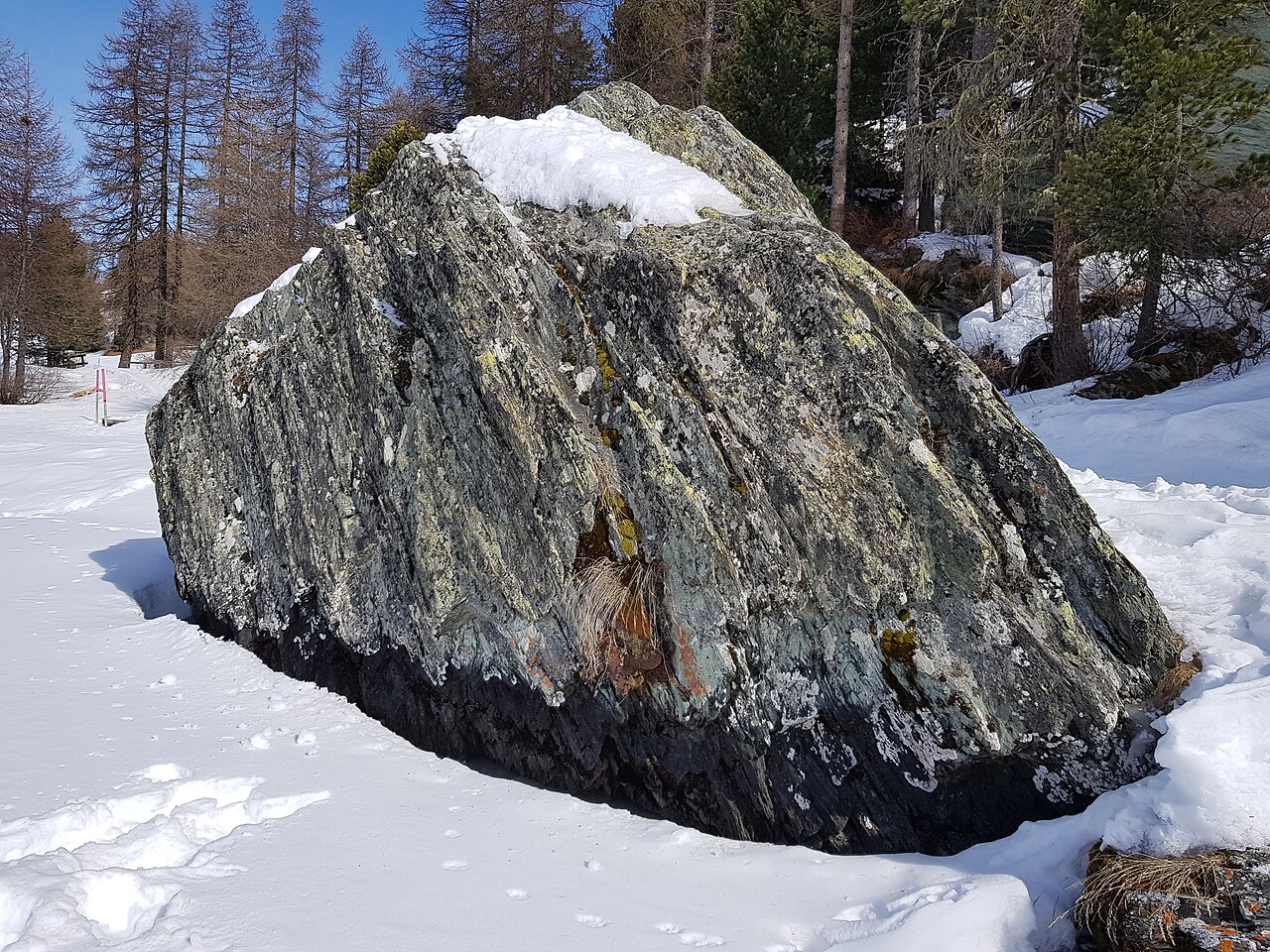 On the map The Zarathustra stone by Lake Silvaplana →
The Use of a Small Room
Some of these rooms can be entered today. Wittgenstein's house opens from April to October, with a key available to rent locally. Mahler's hut is a small museum, and the Durisch house in Sils Maria is now the Nietzsche-Haus. The huts of Heidegger and Næss are private and are best seen from the trail.
At Skjolden, the restored house stands on its original stone foundation above the lake. Wittgenstein's diary gives that view a particular scale: the edge of the sun following a ridge, the first fly at the window, the ice becoming too thin to cross.
Sources and Further Reading
- Stiftinga Wittgenstein, Skjolden — the house, its history and how to visit
- Brian McGuinness (ed.), Wittgenstein in Cambridge: Letters and Documents 1911–1951 (Blackwell, 2008) — letters to Russell (1913) and Moore (1936)
- Wittgenstein Source — Ms-183, the diary of 1936–37 (German)
- Julian Baggini, “If you stand in Wittgenstein's home, will you think like him?” — Aeon, 2019
- “Martin Heidegger” — Stanford Encyclopedia of Philosophy
- Martin-Heidegger-Rundweg — Hochschwarzwald Tourismus
- Jan-Heiner Tück, “Celan und Heidegger in Todtnauberg” — IKaZ Communio, 2020 (German)
- Hans-Peter Kunisch, Todtnauberg: Die Geschichte von Paul Celan, Martin Heidegger und ihrer unmöglichen Begegnung (dtv, 2020)
- “Tvergastein og Skarvereiret” — lokalhistoriewiki.no (Norwegian)
- Arne Næss, Life's Philosophy: Reason and Feeling in a Deeper World (University of Georgia Press, 2002)
- Mahler Foundation — Steinbach am Attersee
- Nietzsche-Haus, Sils Maria — Nietzsche's summers in the Engadin