
 Literature
One midday in the middle of the Cairngorms, Nan Shepherd waded into Loch Avon. The loch lies in a deep trench between Cairn Gorm and Beinn Mheadhoin, hours on foot from the nearest road, and its water is so clear that the stones on the bottom seem close enough to touch. She walked out until she stood on the edge of an underwater shelf and looked past it, down into what she called “the pit that is the true bottom”. Then she waded slowly back into shallower water.
My spirit was as naked as my body. It was one of the most defenceless moments of my life.
The clear water had hidden its own depth. Afterwards, she wrote that the fear had enlarged her spirit rather than shrinking it. The scene appears in The Living Mountain, the short book she wrote after years of walking in this range.
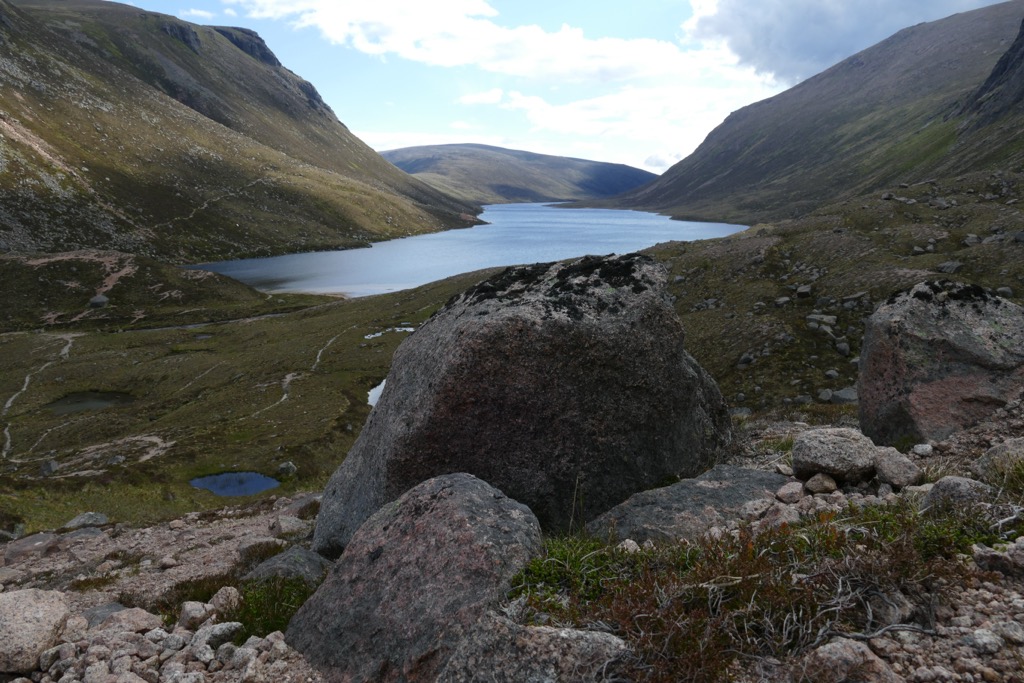
 On the map Loch Avon, where Shepherd waded in →
A Teacher on the River Dee
Anna “Nan” Shepherd was born in 1893 on the western edge of Aberdeen. About a month later her family moved to a house called Dunvegan in the village of Cults, and she lived there for most of her life. For some four decades she taught at the college in Aberdeen that trained the region's teachers. Between 1928 and 1933 she published three novels set in north-east Scotland, and in 1934 a book of poems called In the Cairngorms. After that she published almost nothing for more than forty years.
The river that ran past her house was the Dee. Follow it far enough upstream and you reach the high Cairngorms, where it begins. She walked there sometimes alone and sometimes with friends, students or members of the Deeside Field Club, over many years, in summer and in winter. She remembered seeing the winter plateau for the first time above Glen Einich. She jumped up and down, laughed and shouted, and wrote: “From that hour I belonged to the Cairngorms.”
A Mountain Has an Inside
The Cairngorms are not a ridge of sharp peaks. They form a high granite plateau, part of the largest area of high ground in the UK, much of it above 1,000 metres. The national park calls it the most extensive “arctic” area in the country. The summits are low swellings on that plateau. The drama lies around its edges, in the corries cut into it and in the lochs hidden in its trenches. On her first ascent of Ben Macdui, Shepherd found something she had not expected from a mountain. The top did not simply give her a view. It opened into an interior. In her own words, “a mountain has an inside”.
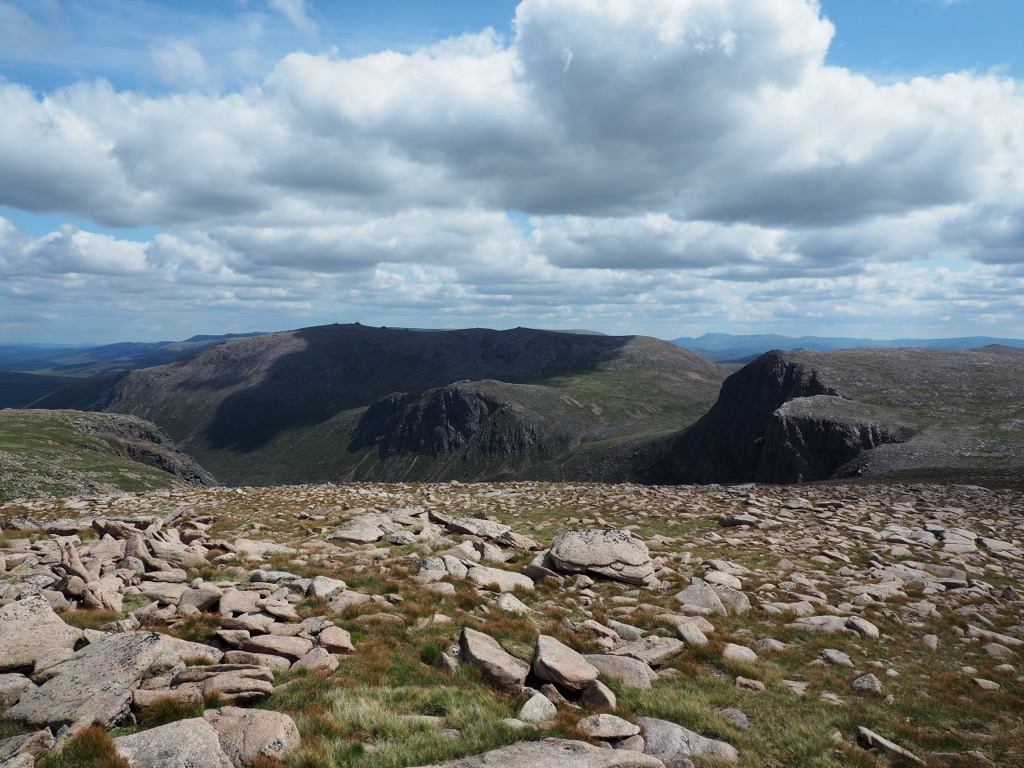
Her title is singular. The Living Mountain is about the whole range, treated as one body with recesses, water, weather, plants, animals and people. Its twelve short chapters move through those parts one by one, and they are not organised around any route to the top. The sentence that readers quote most often explains why:
Yet often the mountain gives itself most completely when I have no destination, when I reach nowhere in particular, but have gone out merely to be with the mountain as one visits a friend with no intention but to be with him.
Robert Macfarlane, whose essays brought her back to a wide readership, describes the book this way: she “tramps around, over, across and into the mountain, rather than charging up it”.
Listening Until the Waterfall Disappears
Her lessons in the range's hidden places began under Braeriach. A man who knew the hill better than she did then took her to Loch Coire an Lochain, a small loch nearly a thousand metres up, tucked into a corrie on the mountain's northern side. She put her fingers in the water and found it cold. Then she sat still.
“I listened to the waterfall until I no longer heard it,” she wrote. The sound had not stopped; she had stopped noticing it as something separate from herself. She came away convinced that haste can do nothing with these hills. She also kept a playful habit for seeing them fresh. She would lie down, or turn her back to the view, bend over and look at the world upside down between her legs. Seen that way, she suggested, the land looks new, the way the earth must see itself.

Loch Coire an Lochain and Braeriach · photo by Jasco, CC BY-SA 4.0, via Wikimedia Commons.
On the map Loch Coire an Lochain, under Braeriach →The Source
The Dee rises on the Braeriach plateau, at about 1,220 metres. It is the highest source of any major river in the British Isles. The same water flows past Cults and reaches the sea at Aberdeen. In the chapter called “Water”, Shepherd follows its sound across the plateau to the Wells of Dee, where water emerges from the rock:
It wells from the rock, and flows away. For unnumbered years it has welled from the rock, and flowed away. It does nothing, absolutely nothing, but be itself.
Shepherd follows the water from springs to burns and lochs, watching how frost and the movement of the stream reshape the ice.
 On the map The Wells of Dee, source of the river →
Sleeping on the Mountain
Shepherd did not only walk the plateau. She slept on it, at night and in the middle of the day. Macfarlane describes her waking to “the sharp press of a robin's claw upon her bare arm or the snuffle of a grazing deer”. She put the point flatly: “No one knows the mountain completely who has not slept on it.”
She was not sentimental about the place. She knew how fast the weather could turn and how hard it was to read, and she counted about a dozen people who had died on these hills in the years she had walked them. She refused to sit in judgement on them. In her view, that risk came with taking responsibility for yourself on the mountain.
Thirty Years in a Drawer
She wrote The Living Mountain in the last years of the Second World War and the months that followed, and finished it around the summer of 1945. She sent the manuscript to her friend, the novelist Neil Gunn. He praised it, but he warned that it would be hard to publish a book like this without photographs and a map. She sent it to a single publisher, received a polite refusal, and put it away.
It stayed in a drawer for more than thirty years. When she finally reread it, she decided that it was still true. Thirty years, she reflected in the foreword, are “the flicker of an eyelid” in the life of a mountain. Aberdeen University Press published it in 1977, when she was eighty-four. She died four years later.

Her reputation grew slowly after that, and then suddenly. In 2008 Macfarlane wrote about her in The Guardian, and in 2011 Canongate reissued the book with his introduction. In 2016 the Royal Bank of Scotland put her portrait on its new £5 note. The Cairngorms appear behind her face, along with a passage from The Living Mountain about “the struggle between frost and the force in running water”. She was the first woman to appear on one of the bank's main-issue notes.
Walking In
Loch Avon is still a walk-in loch. No road reaches it. From the Cairngorm ski area at Coire Cas, paths climb onto the plateau and drop steeply to the head of the loch. From Glenmore, a long low route crosses the col called The Saddle to its outflow. Either way it is a full and serious day. The plateau stands above 1,000 metres, the weather changes fast, and in winter conditions can be arctic. Check the mountain forecast before you set out, and take a map you know how to use.
Writing about one of these hidden lochs, Shepherd made a prediction: “If jeeps find it out, or a funicular railway disfigures it, part of its meaning will be gone.” A funicular railway opened on Cairn Gorm in 2001, though it does not provide a route down to Loch Avon. Access beyond its top station remains restricted. In September 2026, the operator announced a trial allowing unguided summit walks with GPS tracking, authorised until 30 November 2026. Check the operator's current access arrangements before planning a visit. Reaching the loch still means walking in.
Shepherd returned to these hills for decades. In her book, the places she knew best still held surprises: the depth beyond a shelf in Loch Avon, the sound of water under the plateau, a bird's claw on her arm as she woke.
Sources and Further Reading
- Nan Shepherd, The Living Mountain, introduction by Robert Macfarlane — Canongate
- University of Aberdeen — Nan Shepherd: life, work and the manuscript's history
- Robert Macfarlane, “I walk therefore I am” — The Guardian, 2008
- Robert Macfarlane, “How Nan Shepherd remade my vision of the Cairngorms” — The Guardian, 2013
- Nan Shepherd, “Loch Avon” (In the Cairngorms, 1934) — Scottish Poetry Library
- BBC News — Nan Shepherd chosen for the RBS £5 note, 2016
- Cairngorms National Park Authority — the mountains and the plateaux
- CairnGorm Mountain — summit access trial announced in September 2026