
 Architecture
The photograph is always the same. One person stands in a glass box at 3,842 metres, on the top terrace of the Aiguille du Midi above Chamonix. Below their feet is more than a kilometre of air. Behind them, Mont Blanc rises from a sea of cloud. The picture says solitude, courage and silence. The person in the box is alone with the Alps.

Now turn the camera around. Visitors take turns in Step into the Void, wearing slippers that protect the glass. On busy days they wait for that turn in a line behind the door. The wait got so cold that, in January 2017, the operator closed the box briefly to install heating in the waiting room. The solitude in the photograph is real, but it lasts a few seconds. Someone else is always next.
We have all stood in that queue, and this is not a story about other people's vanity. It is a story about a very old habit. Long before phones, mountain tourists wanted the view framed, and wanted proof that they had stood inside the frame. Architects, railway companies and hotel owners have spent two and a half centuries giving them what they wanted. Some of the results are beautiful. A few are quietly subversive.

 On the map Step into the Void, Aiguille du Midi →
A Mirror in the Pocket
In the eighteenth century, fashionable travellers to the English Lakes carried a small convex mirror backed with dark foil. It was later called a Claude glass, after the painter Claude Lorrain, because it turned any view into something that looked like his paintings: smaller, darker, smoother and neatly framed. To use it you turned your back on the landscape and looked at it over your shoulder, in the glass.
The poet Thomas Gray toured the Lake District in October 1769 with one of these mirrors, about four inches across and “bound up like a pocket-book”. In Keswick on 2 October he set off alone to watch the sunset and recorded the result in his journal:
Dined by two o'clock at the Queen's Head, & then straggled out alone to the Parsonage, fell down on my back across a dirty lane with my glass open in one hand, but broke only my knuckles: stay'd nevertheless, & saw the sun set in all its glory.
Two days later he was back at the same spot before sunset, and he described what he saw in the mirror as a commodity. It was “a picture, that if I could transmitt to you, & fix it in all the softness of its living colours, would fairly sell for a thousand pounds.” He also wrote down the local names of his best viewpoints so that “any body may enquire on the place, & easily find the particular station.” A man walking backwards into a lane, then sharing the location of the perfect shot: Gray had invented most of the modern viewpoint except the hashtag.


“The Sun Isn't the Spectacle”
By the nineteenth century the Swiss had turned the sunrise into an industry. The Rigi, above Lake Lucerne, got its first summit guesthouse in 1816, with six beds. Three years later more than a thousand visitors a year were climbing up. By 1860 the village of Weggis kept about a thousand horses, along with chair-carriers and guides, to haul tourists to the top. In 1871 the Rigi got Europe's first mountain railway. At the summit hotel an alphorn woke the guests before dawn, so that nobody missed the moment.
Mark Twain went up in 1878 and wrote it up in A Tramp Abroad, with his travelling companion “Harris”. They overslept and were woken by the horn, and they rushed out in red hotel blankets to the wooden scaffold on the summit. They stood there admiring the glorious sunrise until they realised it was half past seven in the evening and the sun was going down. Below them, a crowd in its best clothes was watching, and Harris understood exactly what was being looked at:
Look here, the sun isn't the spectacle—it's us—stacked up here on top of this gallows, in these idiotic blankets, and two hundred and fifty well-dressed men and women down here gawking up at us and not caring a straw whether the sun rises or sets, as long as they've got such a ridiculous spectacle as this to set down in their memorandum-books.
Swap the memorandum-books for phones and the scene needs no other update. The view had already become a backdrop, and the people in front of it had become the picture.
 On the map Rigi Kulm →
Railways to the View
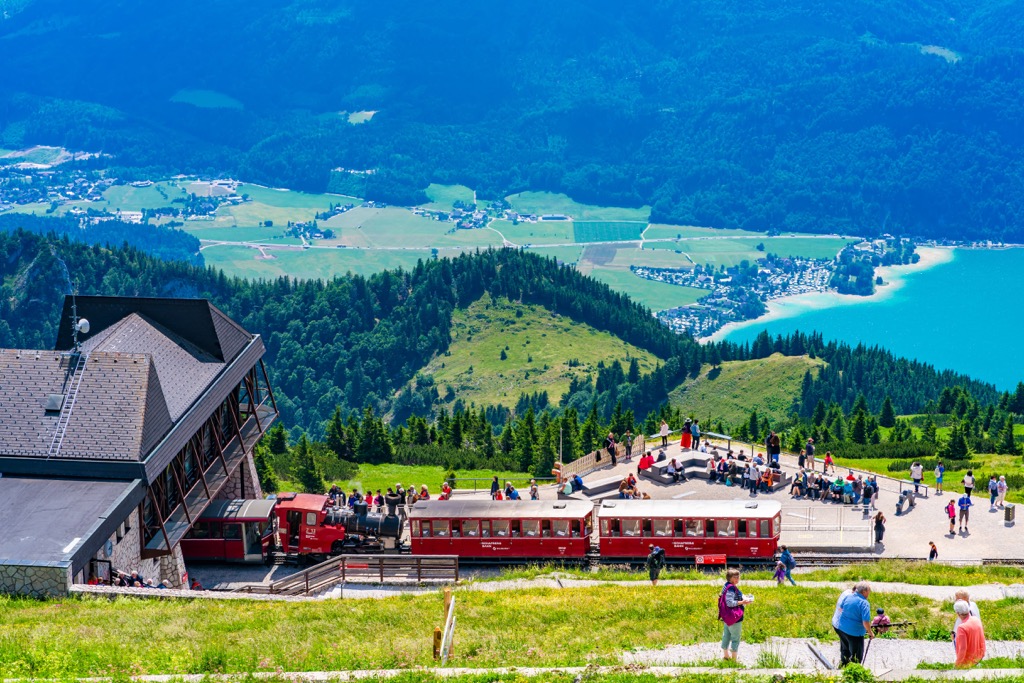
Across the Alps, the Rigi model spread: build a railway, put a hotel at the top, sell the panorama. On the Schafberg above Wolfgangsee, early visitors from Vienna were carried up by a guild of chair-carriers with fixed tariffs and strict rules. In 1893 a rack railway replaced them. Its original steam locomotives still run on a few nostalgia days each summer. On ordinary days the summit is busy enough that every ticket down comes with a booked time slot, and at peak times trains leave every twenty minutes. From the top you can see some of the Salzkammergut's lakes laid out like a map, and you see them with a lot of company.
 On the map Schafberg summit station →
The poster did the rest. In 1908 the Bernese artist Emil Cardinaux drew the Matterhorn glowing gold against a pink sky, above a dark forested ridge, with ZERMATT in large letters across the bottom. The poster made him known internationally, and he is counted among the founders of Swiss poster art. Before most travellers saw the mountain itself, they had seen it framed, simplified and coloured for them.

Black Mirrors at the Canyon
The same idea crossed the Atlantic. In 1932 the architect Mary Colter built the Desert View Watchtower on the South Rim of the Grand Canyon for the Fred Harvey Company and the Santa Fe Railway, which brought tourists to the canyon by train. Her stated aim was a building that would “create no discordant note” against the canyon walls. The tower's stone skin hides a steel frame, and its interior is painted with murals by the Hopi artist Fred Kabotie.
At the windows of its lower View Room hang what the National Park Service calls reflectoscopes. They are viewing boxes with polished black glass mirrors, there to cut the glare and bring out the colours of the rock. A visitor at the edge of one of the largest views on Earth is invited to look at it in a dark mirror. Gray would have understood at once.
 On the map Desert View Watchtower, Grand Canyon →
Windows Ordered Like Picture Frames
Modern architects make the frame out of the building itself. On the Kronplatz in South Tyrol, at 2,275 metres, Zaha Hadid Architects buried a museum of mountaineering inside the summit for Reinhold Messner. It opened in 2015. Little of it shows above the surface except a few concrete openings that stare out of the hill. Messner's brief told the architects exactly what each opening should hold: one window facing southwest to the Peitlerkofel, another facing south to the Heiligkreuzkofel, and a balcony facing west to the Ortler. He chose the peaks the way you might choose pictures for a living room. The Heiligkreuzkofel, he said, had given him the most difficult climb of his life.

MMM Corones on the Kronplatz · Marco Almbauer, CC BY 3.0, via Wikimedia Commons.
On the map MMM Corones, Kronplatz →When the Frame Becomes the Product
On the Schilthorn above Mürren, the frame came from the cinema. In 1968 the makers of the James Bond film On Her Majesty's Secret Service found a revolving restaurant under construction on the summit, at 2,970 metres, and turned it into the villain's lair. The building kept the lair's name from Ian Fleming's novel: Piz Gloria. It still turns once every 45 minutes, and the summit has a Bond exhibition and a walk of fame. The operator now advertises the restaurant's windows as a ready-made frame: “the panoramic windows themselves become the perfect photo spot.”

Piz Gloria on the Schilthorn, drone photo · Schilthornbahn, CC BY-SA 4.0, via Wikimedia Commons.
On the map Piz Gloria, Schilthorn →The newest step was taken on Klein Titlis above Engelberg in 2026. Herzog & de Meuron rebuilt a 1980s telecom tower into the TITLIS Tower, with a 360-degree viewing deck at the top and a fine-dining restaurant below it. Below the restaurant, by the operator's own account, is the highest Rolex boutique in the world. Next door is the Cliff Walk, a suspension bridge over a sheer drop, with automatic cameras that photograph the people crossing it. When it was opened in December 2012, a snowstorm left the guests of honour able to see only a few metres. Even the most carefully built frame is at the mercy of the weather.
On the map TITLIS Tower, Klein Titlis →A Mirror on the Roof
This summer the Norwegian firm Snøhetta, working from its studio in Innsbruck, finished the Lech Mountain Mirror. It sits on the roof of the Zugerbergbahn top station above Lech, at about 2,100 metres. It is a shallow pool of water with stepping stones leading to a rock that rises from its surface. On a still day the pool holds a second set of peaks, and anyone who walks out onto the rock appears in the reflection. Snøhetta's own description is frank about both sides of the project: “The reflections of mountains and sky, clouds and people merge into an image,” and the mirror “also makes for an impressive photo spot.” The pool is free to visit and holds water only from June to October.
It is, in effect, a Claude glass the size of a swimming pool, laid on the ground. Yet the same valley holds a different answer to the same question. A few kilometres away, on the hill of Tannegg above Oberlech, James Turrell built a Skyspace in 2018. You enter through a tunnel, fifteen metres long, that frames a single peak, the Biberkopf. Then you reach an oval chamber with a black granite bench and an opening in the roof. There is no mountain in it at all, only the sky, changing colour. The piece is meant for sunrise and sunset, in fair weather. “My desire,” Turrell has said, “is to set up a situation to which I take you and let you see. It becomes your experience.” It is very hard to take a good selfie in it.

Skyspace Lech by James Turrell · Margit Schäfer, CC BY-SA 4.0, via Wikimedia Commons.
On the map Skyspace Lech, Tannegg above Oberlech →A Window Under the Sea
Snøhetta has also built a frame that points the other way. At Lindesnes, the southern tip of Norway, sea storms from the north and the south meet and the weather can change several times a day. There, in 2019, the firm sank a 34-metre concrete monolith into the water. It is the restaurant Under. One end rests on the rocks and the other on the seabed about five metres down, and its walls are half a metre thick. Guests walk down a long wooden stair towards a window eleven metres wide that, in the architects' words, works “like a sunken periscope”. What it shows is not peaks but kelp, fish and the light changing in the water. The rough concrete shell is meant to become an artificial reef, and the building also serves as a marine research station.
In Norwegian, “under” means both “below” and “wonder”. Snøhetta's description of the place is the best caption for every building in this story: “In this building, you may find yourself under water, over the seabed, between land and sea.” Here, at least, the view cannot be arranged for the camera. The sea decides what appears in the window.

 On the map Under, Lindesnes →
Quiet Frames
Some mountain buildings frame the view in order to slow you down. At Alpe Foppa on Monte Tamaro in Ticino, at the top of the gondola from Rivera, Mario Botta built the chapel of Santa Maria degli Angeli between 1992 and 1996. He made it for Egidio Cattaneo, the man behind the Monte Tamaro lifts. It is a long stone walkway that runs out over the valley and ends at a cross. One description of the project says the cross “frames and directs the gaze like an optical sight”. You can climb down the stepped roof as if it were an amphitheatre and sit. Botta himself remembered his first visit plainly: “Quando son salito sul Tamaro mi son spaventato.” When he went up the Tamaro, he was frightened.

Santa Maria degli Angeli on Monte Tamaro · Monster4711, CC0, via Wikimedia Commons.
On the map Santa Maria degli Angeli, Monte Tamaro →Facing the Mountain That Gave the Name
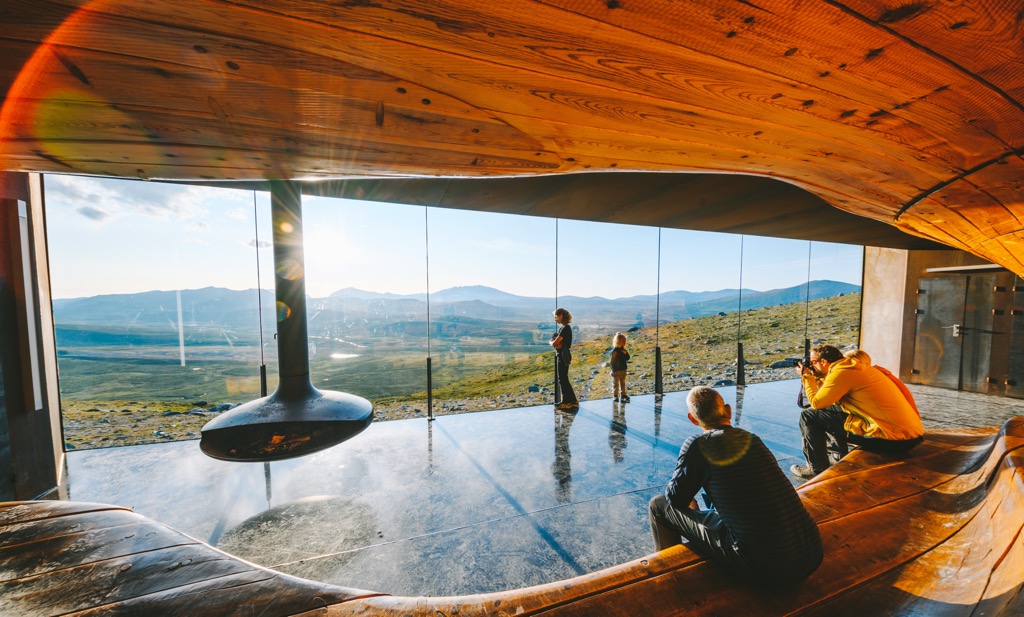
The last building belongs to the same firm as the mirror in Lech. Snøhetta takes its name from a remote mountain massif in Dovrefjell, in central Norway. “Snøhetta is a place nobody is from,” the firm says, “but anyone can experience.” In 2011 it built a small pavilion there for the Norwegian Wild Reindeer Foundation, at about 1,200 metres on Tverrfjellet near Hjerkinn. To reach it you walk a gravel trail of one and a half kilometres. The building is a box of raw steel and glass around a wooden core, milled to look like rock worn down by wind and water, with a bench running along it and a fire in the middle. Through the glass, across the open plateau, stands the mountain Snøhetta. With luck, Europe's last wild reindeer cross the view.
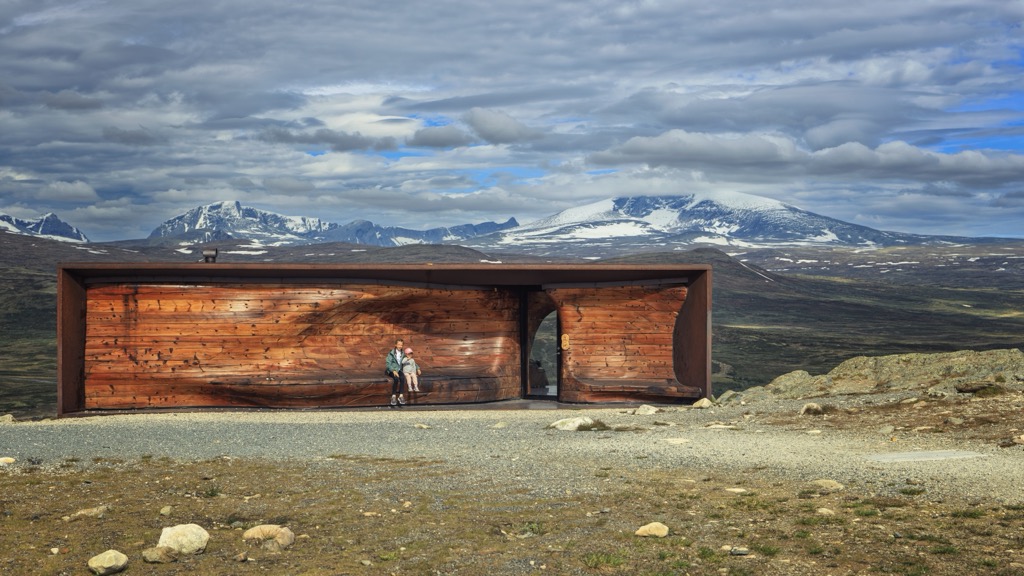
It is a quiet place, and people photograph it anyway: pictures of the interior are full of raised phones and cameras. That is fine. The pavilion asks for something a photograph cannot hold: an hour. Sit until the reindeer come or do not come, and until the mountain changes colour with the light. Then the frame stops being a backdrop and becomes what it was meant to be, a window.
How to Stand in the Frame
None of this is a reason to stay away. These places are popular for good reasons, and you are allowed to want the photograph. A few habits help the view survive the crowd:
- Take the first lift. At the Aiguille du Midi, on the Schafberg or on the Schilthorn, the first hour belongs to the mountain, not to the queue.
- Go in bad weather. Cloud empties the terraces, and the view that appears through a gap lasts longer in the memory than a clear blue backdrop.
- Turn around. Twain's best scene happened because he looked the wrong way. The crowd, the light on the other side, the valley you came up from are part of the place too.
- Stay after the photo. Ten more minutes is usually enough for a framed view to become a real one.
Gray fell on his back in a dirty lane with his mirror open, and he stayed anyway to watch the sun go down. Two and a half centuries later that is still the right instinct. Take the picture, then put the glass away and look.
Sources and Further Reading
- Thomas Gray, journal of the Lakes, 2 October 1769 — Thomas Gray Archive; 3–4 October 1769
- Mapping the Lakes: Thomas Gray's tour — Lancaster University
- Mark Twain, A Tramp Abroad (1880), chapters XXVIII–XXIX — Project Gutenberg
- Mount Rigi through the ages — Rigi Bahnen
- History of the SchafbergBahn (German)
- The Story of Desert View Watchtower — National Park Service
- Messner Mountain Museum Corones — Zaha Hadid Architects project text
- Piz Gloria — Schilthorn
- TITLIS Tower — Herzog & de Meuron
- Lech Mountain Mirror — Snøhetta
- Skyspace Lech — Lech Zürs Tourismus
- Under — Snøhetta
- History of Monte Tamaro
- Tverrfjellhytta, Norwegian Wild Reindeer Pavilion — Snøhetta