
 Music
MusicOn 19 June 1835, Franz Liszt and Marie d’Agoult reached Weesen and took a boat onto Lake Walen. Decades later she remembered him writing a “melancholy harmony” there, imitating the sigh of the waves and the cadence of the oars. The sentence turns a piano piece back into a scene: two travellers, a moving boat and a rhythm supplied by the lake.
They had left Paris under scandal. D’Agoult was married and the mother of two children; Liszt was twenty-three. They met in Basel, crossed Switzerland and settled in Geneva in July. Music emerged from the journey, but the first Année de pèlerinage was not a diary copied onto the keyboard. D’Agoult wrote from memory, and Liszt kept revising: the Swiss book reached its published form only in 1855.
Lake Walen: The Rhythm of Oars
Au lac de Wallenstadt stayed unusually close to its early form. The left hand rocks in even figures while the melody moves without hurry above it. Listen for the restraint. The famous virtuoso does not try to overpower the landscape; the music holds to a repeated motion, as if the boat is still crossing the water.

 On the map Lake Walen beneath the Churfirsten ridge →
Lake Uri: A Chapel and a Political Sound
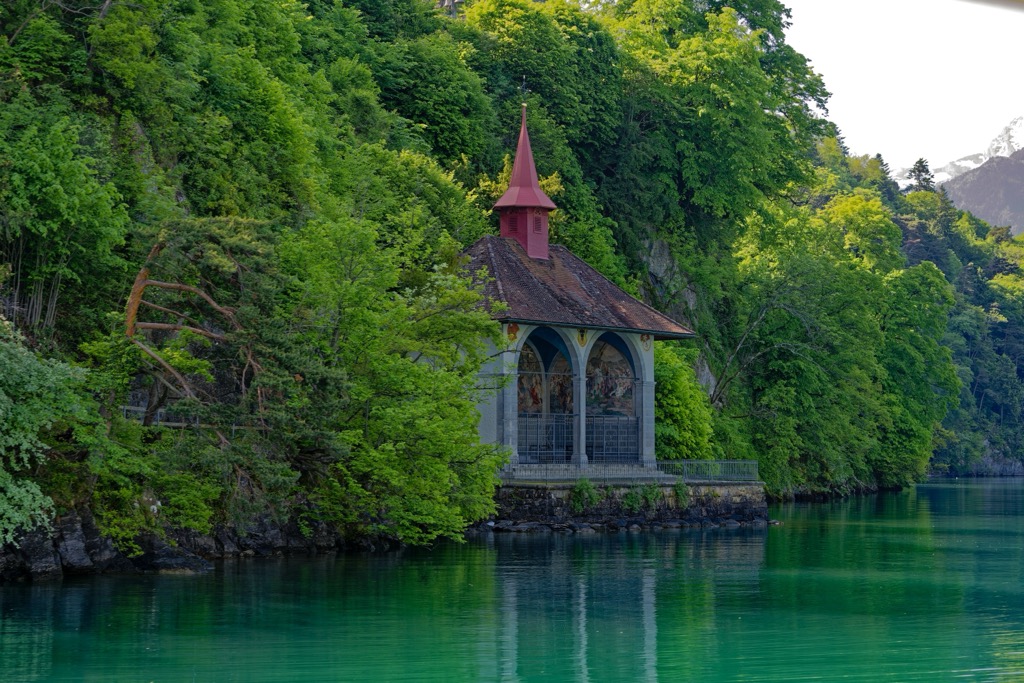
Farther west, the journey entered Canton Uri and the landscape of the William Tell tradition. Liszt later made Chapelle de Guillaume Tell the opening piece of the Swiss book. It is not simply a portrait of a building. Expanding chords, an alphorn-like middle section and the motto “Einer für Alle — Alle für Einen” turn the chapel into a place where landscape and political memory meet.
The phrase is often attributed to Schiller, but it does not appear verbatim in Wilhelm Tell. The physical landmark also changed: Liszt knew the earlier chapel, not the present building completed in 1879. The shore is continuous; the architecture is not.
Listen for the opening chords and distant horn calls
 Listen on YouTube · Lazar Berman
Lazar Berman, Deutsche Grammophon (1977) · also on Spotify
On the map Tellskapelle on the shore of Lake Uri →Geneva: Bells and a New Household
In Geneva, Liszt taught at the newly founded conservatoire, and the couple’s daughter Blandine was born on 18 December 1835. An early version of Les cloches de Genève was dedicated to her. The journey had become domestic life: lessons, a child and a city heard day after day.
Liszt later discarded much of the early piece and wrote a new second section. In the final version, the distant bells return after a melody that grows from quiet to full intensity. Listen for memory changing scale: a city sound becomes both private dedication and public concert music.
The commemorative plaque at today’s Place Franz-Liszt does not mark a verified home. The building was completed in 1836, and Geneva’s archival research indicates that the couple never lived there. The map pin is therefore a memorial site, not a documented doorstep.
 On the map The Liszt memorial in Geneva Old Town →
From Journey to Score
The map keeps three anchors, not a continuous modern itinerary. More importantly, the score does not preserve them as untouched souvenirs. Lake Walen survives with unusual directness; Tell’s Chapel and Geneva were rethought as Liszt's musical language changed.
That distance between 1835 and 1855 is part of the story. Water, oars, political legend, bells and the birth of a daughter entered memory at different depths. The Swiss landscape did not dictate the music. It gave Liszt material he could keep hearing differently.