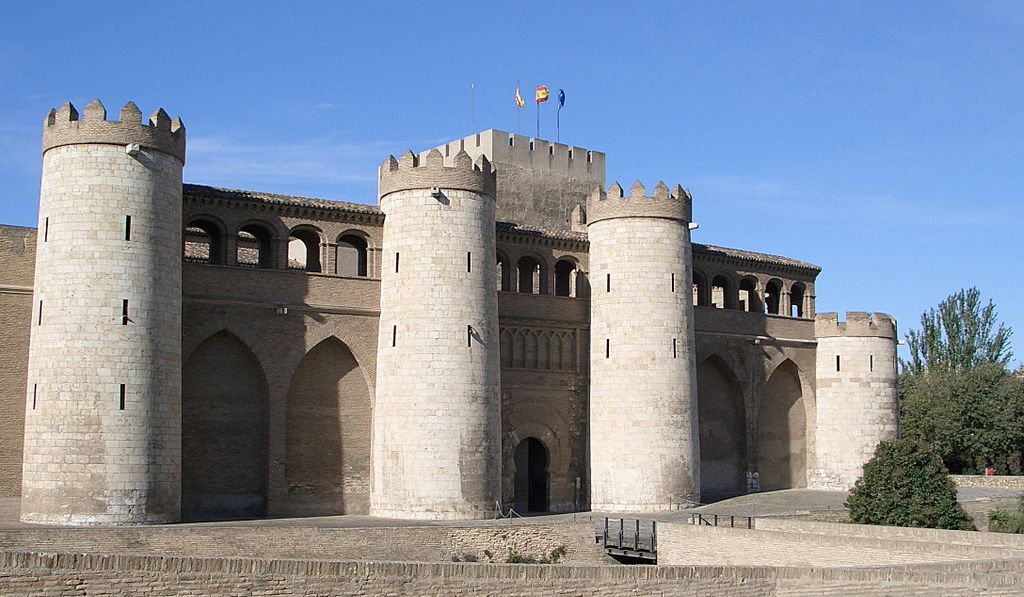
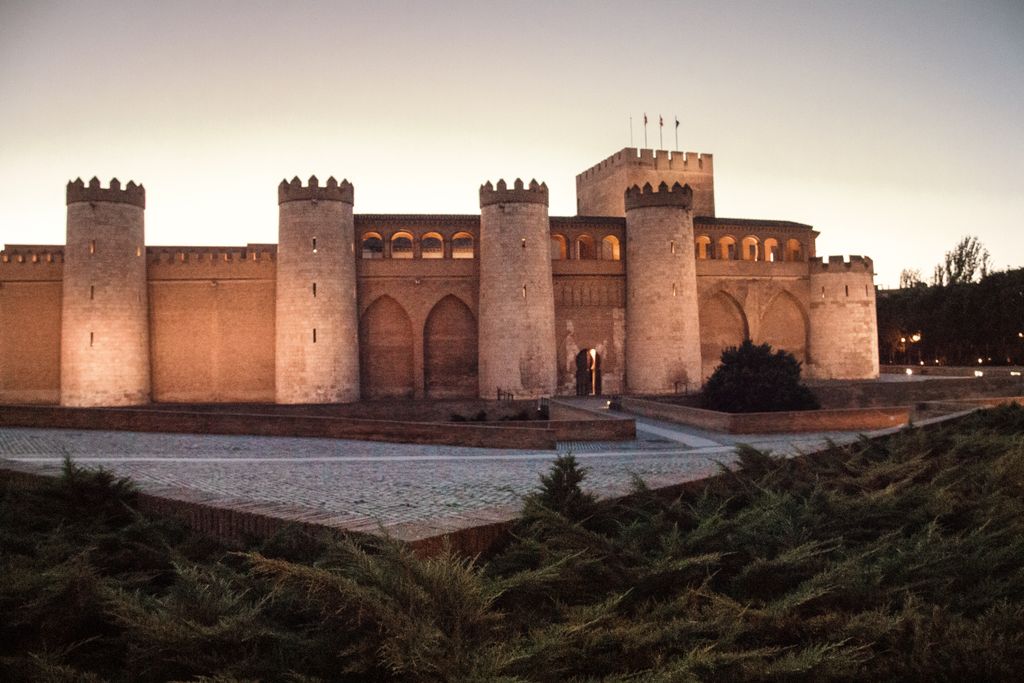
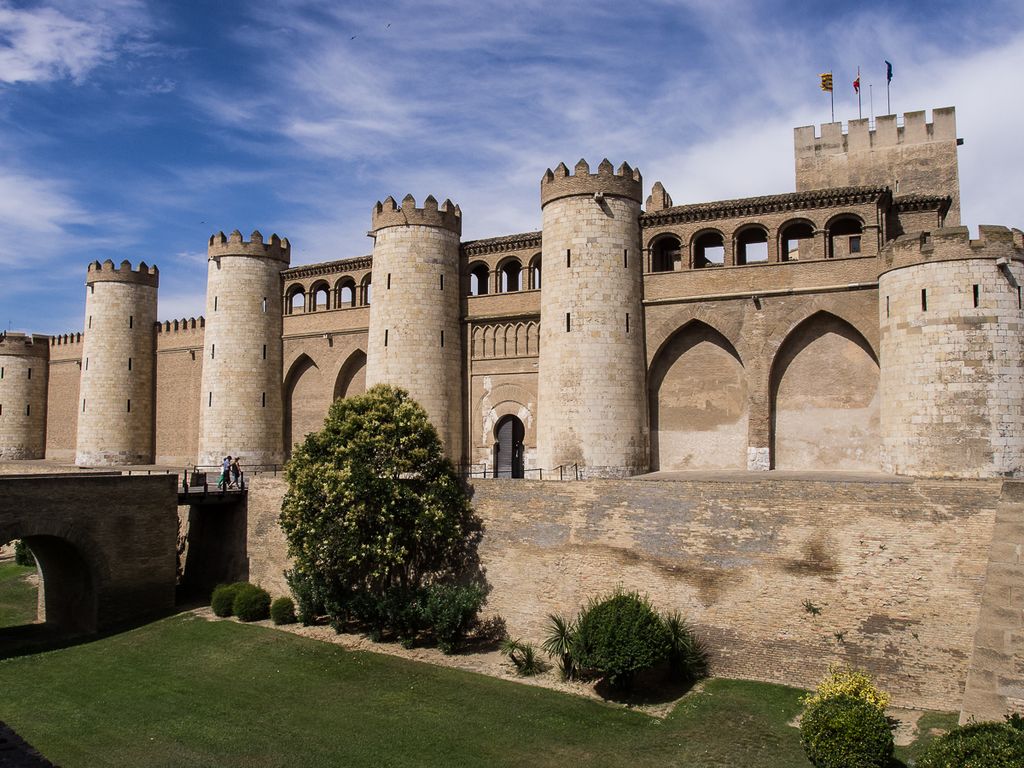
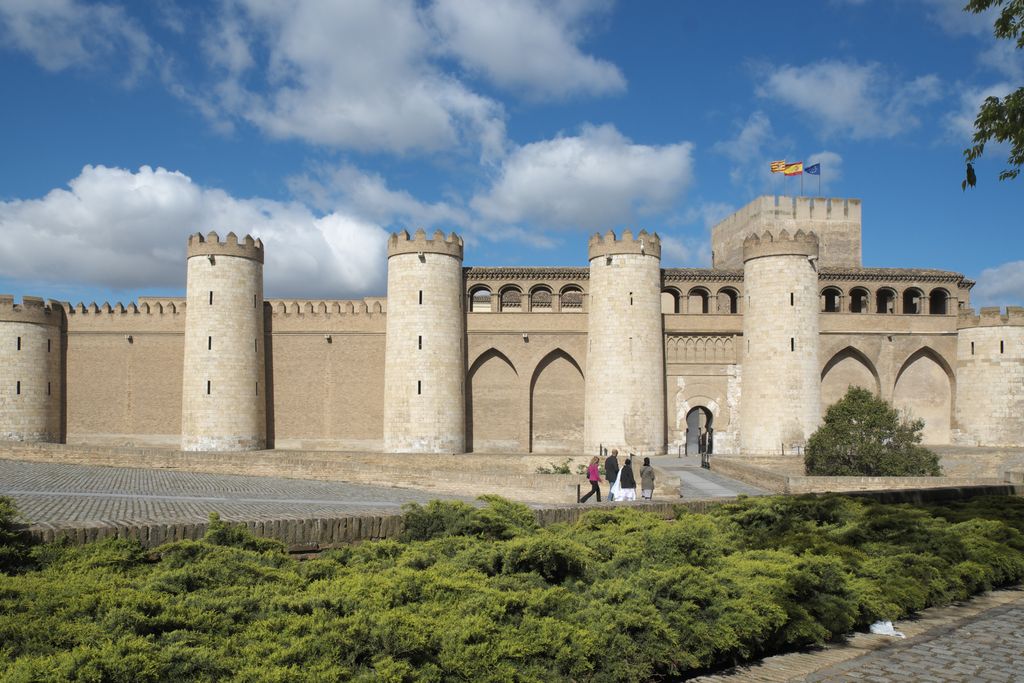
The Aljafería Palace (Spanish: Palacio de la Aljafería; Arabic: قصر الجعفرية, tr. Qaṣr al-Jaʿfariyah) is a fortified medieval palace built during the second half of the 11th century in the Taifa of Zaragoza in Al-Andalus, present day Zaragoza, Aragon, Spain. It was the residence of the Banu Hud dynasty during the era of Abu Jaffar Al-Muqtadir. The palace reflects the splendor attained by the Taifa of Zaragoza at its height. It currently houses the Cortes (regional parliament) of the autonomous community of Aragon. The structure is the only conserved large example of Spanish Islamic architecture from the era of the taifas (independent kingdoms). The Aljafería, along with the Mosque–Cathedral of Córdoba and the Alhambra, are the three best examples of Hispano-Muslim architecture and have special legal protection. In 2001, the original restored structures of the Aljafería were included in the Mudéjar Architecture of Aragon, a World Heritage Site. The style of ornamentation of the Aljafería, such as the use of mixtilinear arches and springers, the extension of arabesques over a large area, and the schematisation and progressive abstraction of the yeserias of a vegetal nature, strongly influenced Almoravid and Almohad art in the Iberian Peninsula. The shift in decoration towards more geometric motifs is at the basis of Nasrid art. After the reconquest of Zaragoza in 1118 by Alfonso I of Aragón, it became the residence of the Christian kings of the Kingdom of Aragón. It was used as a royal residence by Peter IV of Aragón (1319–1387) and, in 1492, it was converted into the palace of the Catholic Monarchs. In 1593 it underwent another restructuring that would turn it into a military fortress, first according to Renaissance designs (which today can be seen in its surroundings, moat, and gardens) and later for quartering military regiments. It underwent further restructuring and damage, especially with the Sieges of Zaragoza of the Peninsular War, until it was finally restored in the 20th century. The palace was built outside Zaragoza's Roman walls, in the plain of the saría. With urban expansion over the centuries, it is now inside the city.
We use GPS information embedded into the photo when it is available.
3D mountains overlay
Adjust mountain panorama to perfectly match your photos because recorded by camera photo position might be imprecise.
Move tool
Rotate tool
Zoom
More customization
Choose which peak labels should make into the final photo and what photo title should be.
Next
Photo Location
Satellitte
Flat map
Relief map
Latitude
Longitude
Altitude
OR
Latitude
°'''
Longitude
°'''
Apply
Register Peak
Peak Name
Latitude
Longitude
Altitude
Register
Teleport
PeakVisor
This 3D model of Sagarmatha National Park in Nepal was made using the PeakVisor app topographic data. The mobile app features higher precision models worldwide, more topographic details, and works offline. Download PeakVisor maps today.
Download OBJ model
PeakVisor
The download should start shortly. If you find it useful please consider supporting the PeakVisor app.
PeakVisor for iOS and Android
Be a superhero of outdoor navigation with state-of-the-art 3D maps and mountain identification in the palm of your hand!