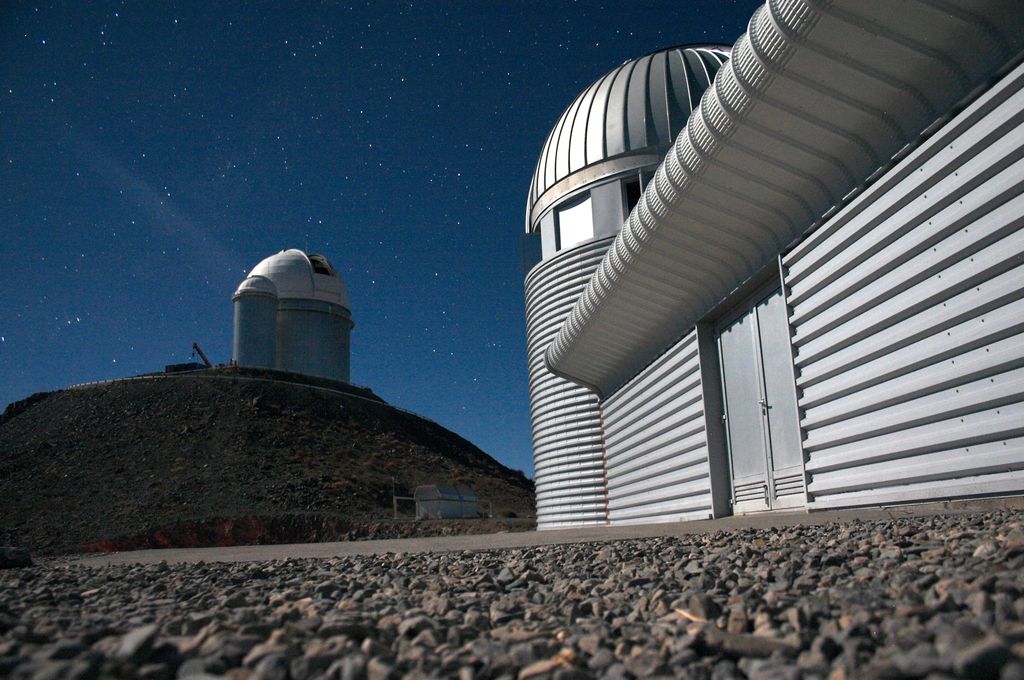
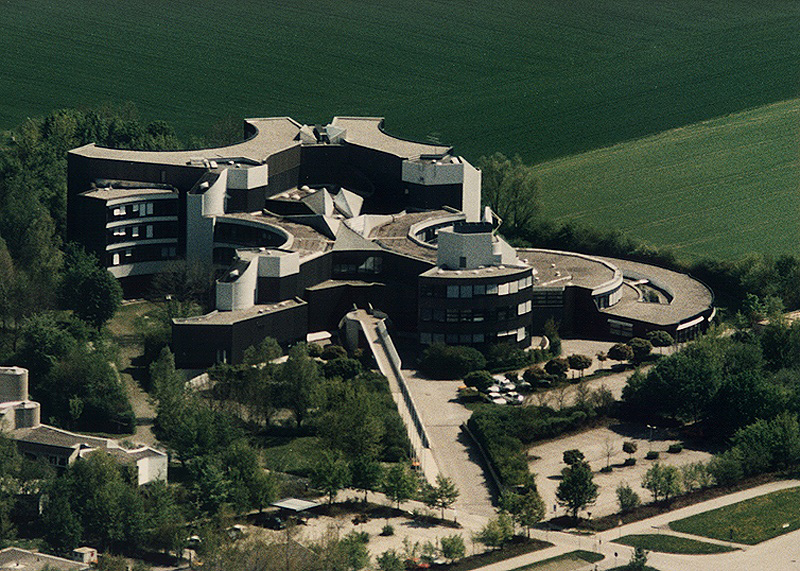
The European Organisation for Astronomical Research in the Southern Hemisphere, commonly referred to as the European Southern Observatory (ESO), is an intergovernmental research organisation made up of 16 member states for ground-based astronomy. Created in 1962, ESO has provided astronomers with state-of-the-art research facilities and access to the southern sky. The organisation employs over 750 staff members and receives annual member state contributions of approximately €162 million. Its observatories are located in northern Chile. ESO has built and operated some of the largest and most technologically advanced telescopes. These include the 3.6 m New Technology Telescope, an early pioneer in the use of active optics, and the Very Large Telescope (VLT), which consists of four individual 8.2 m telescopes and four smaller auxiliary telescopes which can all work together or separately. The Atacama Large Millimeter Array observes the universe in the millimetre and submillimetre wavelength ranges, and is the world's largest ground-based astronomy project to date. It was completed in March 2013 in an international collaboration by Europe (represented by ESO), North America, East Asia and Chile. Currently under construction is the Extremely Large Telescope. It will use a 39.3-metre-diameter segmented mirror, and become the world's largest optical reflecting telescope when operational towards the end of this decade. Its light-gathering power will allow detailed studies of planets around other stars, the first objects in the universe, supermassive black holes, and the nature and distribution of the dark matter and dark energy which dominate the universe. ESO's observing facilities have made astronomical discoveries and produced several astronomical catalogues. Its findings include the discovery of the most distant gamma-ray burst and evidence for a black hole at the centre of the Milky Way. In 2004, the VLT allowed astronomers to obtain the first picture of an extrasolar planet (2M1207b) orbiting a brown dwarf 173 light-years away. The High Accuracy Radial Velocity Planet Searcher (HARPS) instrument installed on the older ESO 3.6 m telescope led to the discovery of extrasolar planets, including Gliese 581c—one of the smallest planets seen outside the Solar System.
Show more
Sun and Moon
Mon
Tue
Wed
Thu
Fri
Sat
Sun
May 2022
Date and time
00:00
06:00
12:00
18:00
Today
--
--
Sunrise
--
Sunset
--
Moonrise
--
Moonset
Phase
🌔 Waxing Gibbous
The perfect light time for beautiful photos:
--
Sunrise
--
Sunset
PeakVisor app
Get the app on your smartphone
New Panorama Tools
Trace location on the map
Measure distances
All the instruments are available in the context menu as well.
We use GPS information embedded into the photo when it is available.
3D mountains overlay
Adjust mountain panorama to perfectly match your photos because recorded by camera photo position might be imprecise.
Move tool
Rotate tool
Zoom
More customization
Choose which peak labels should make into the final photo and what photo title should be.
Next
Photo Location
Satellitte
Flat map
Relief map
Latitude
Longitude
Altitude
OR
Latitude
°'''
Longitude
°'''
Apply
Register Peak
Peak Name
Latitude
Longitude
Altitude
Register
Teleport
PeakVisor
This 3D model of Sagarmatha National Park in Nepal was made using the PeakVisor app topographic data. The mobile app features higher precision models worldwide, more topographic details, and works offline. Download PeakVisor maps today.
Download OBJ model
PeakVisor
The download should start shortly. If you find it useful please consider supporting the PeakVisor app.
PeakVisor for iOS and Android
Be a superhero of outdoor navigation with state-of-the-art 3D maps and mountain identification in the palm of your hand!