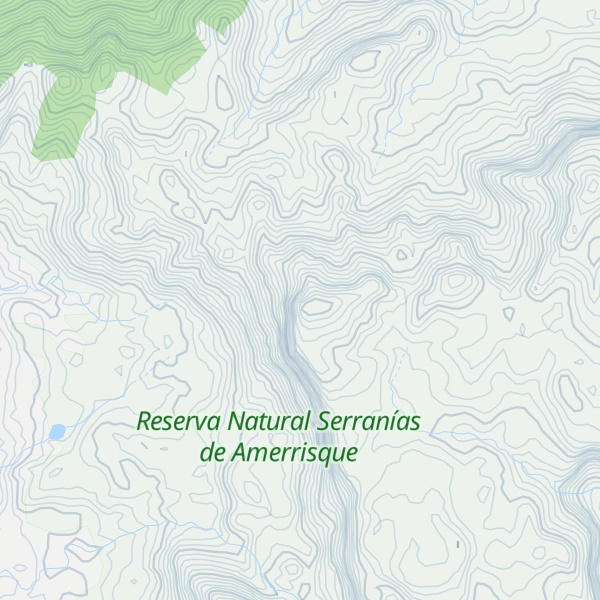
The Amerrisque Mountains (Spanish: Serranías de Amerrisque, Cordillera de Amerrisque) are the central spine of Nicaragua and part of the Central American Range which extends throughout central Nicaragua for about 700 km (430 mi) from Honduras in the northwest to Costa Rica in the southwest, just a few miles from the Caribbean. The Amerrisques also are known as Cordillera Chontaleña at their central range. Its coordinates are 12°12'0" N and 85°19'0" W in DMS (degrees minutes seconds) or 12.2 and -85.3167 (in decimal degrees) and is 329 meters above sea level.
Amerrique is the Mayan name of the mountains between Juigalpa and Libertad in the Chontales Department in Nicaragua; these mountains separate Lake Nicaragua from the Mosquito Coast. The Mayan name Amerrique signifies "the country of the wind", "the country where the wind blows constantly". The range is named after the Amerrisque tribe, who are fast fading away. It is supposed that the Amerrisques were once powerful, but very little is known concerning them. The decay of their speech went on for a long time before contact with Europeans, and the name by which the people and the mountains are now known is, not improbably, the bare remnant of the original word, which may very well have been something like Amerristiquiqque, shortened successively to Amerristique and Amerrisque.
As Nicaragua's divide, the Amerrisques contain some high peaks such as Pataste (1736 m) in Madriz Region, Quiabuc (1604 m) in Estelí Region, and Chagüite (1345 m) in Matagalpa Region. At the same time, they are the source of many rivers such as the Segovia (775 km), the Siquia-Escondido (207 km), while crisscrossed by rivers born at other ranges such as the Grande (500 km), the Viejo (209 km), etc. The range also separates the Great Lakes Xolotlán and Cocibolca in Western Nicaragua, from the Mosquito Coast in Eastern Nicaragua.
The Amerrisques boast a rich flora, due to their latitude and altitude, which ranges from sub-alpine, by Honduras, to tropical, by Costa Rica. Species range from unique regionals such as madroño, espavel, and chilamate to North American species such as pine, oak, sweetgum, and terebinth, and South Americans such as gumtree, mahogany, and rosewood.
The fauna includes mountain lions, coyotes, ocelots; deer, guatusas, tapirs; anteaters, armadillos, quetzals; guardabarrancos, toucans, harpy eagles; great owls, roadrunners, rattlesnakes; corals, fer-de-lance, etc. While the northern parts of the range are pine or oak-clad, the central parts sport dry-to-rainy forests and cattle ranching. The southern heights are covered in thick jungles along the San Juan River.
Some important cities located at the feet of the Amerrisques include Estelí (210,000), a cultural and manufacturing center, and Juigalpa (110,000), a cattle ranching area.
We use GPS information embedded into the photo when it is available.
3D mountains overlay
Adjust mountain panorama to perfectly match your photos because recorded by camera photo position might be imprecise.
Move tool
Rotate tool
Zoom
More customization
Choose which peak labels should make into the final photo and what photo title should be.
Next
Photo Location
Coordinates work here too — paste them as 69.72728, 20.61890 and press Enter
Satellitte
Flat map
Relief map
Latitude
Longitude
Altitude
OR
Latitude
°'''
Longitude
°'''
Apply
Register Peak
Peak Name
Latitude
Longitude
Altitude
Register
Teleport
PeakVisor
This 3D model of Sagarmatha National Park in Nepal was made using the PeakVisor app topographic data. The mobile app features higher precision models worldwide, more topographic details, and works offline. Download PeakVisor maps today.
Download OBJ model
PeakVisor
The download should start shortly. If you find it useful please consider supporting the PeakVisor app.
PeakVisor for iOS and Android
Be a superhero of outdoor navigation with state-of-the-art 3D maps and mountain identification in the palm of your hand!