
Scan the QR code and open PeakVisor on your phone
City of Nottingham is home to 5 named mountains. The highest is Mapperley at 134 m.
Nottingham is a city in the East Midlands region of England and the county town of Nottinghamshire. Here, you can follow the footsteps of legendary outlaw Robin Hood and discover ancient woodlands, medieval castles, and one of Britain's oldest pubs. There are 5 named hills in the City of Nottingham. Mapperley (134 m / 440 ft) is the highest point. The most prominent hill is Arbour Hill (68 m / 223 ft).

Nottingham is the largest urban area in the East Midlands, with a population of over 768,000. The city rests within the River Trent’s lower valley on a series of low hills rarely exceeding 100 m (328 ft) in elevation. The River Trent is the UK’s third longest river, meandering 185 mi (298 km) from Staffordshire to Lincolnshire.
The landscape around Nottingham isn't particularly dramatic, with no significant hills to scale; however, there is plenty of green space where hikers can reconnect with nature. The Nottingham and Derby Green Belt prevents over 234 sq mi (607 sq km) of land around Nottingham and nearby Derby from being developed, helping protect Nottinghamshire's natural environment.
Less than 25 mi (40 km) north of Nottingham is Sherwood Forest, the legendary home of Robin Hood. Sherwood Forest dates back to at least the 11th century and has Europe's highest concentration of ancient trees.
Roughly 30 mi (48 km) northwest of Nottingham is the Peak District National Park — the UK's first national park, opened in 1951. Other important protected landscapes include the Attenborough Nature Reserve, 5 mi (8 km) southwest of Nottingham, and the 500-acre (202 ha) Wollaton Park, the city's largest urban park.
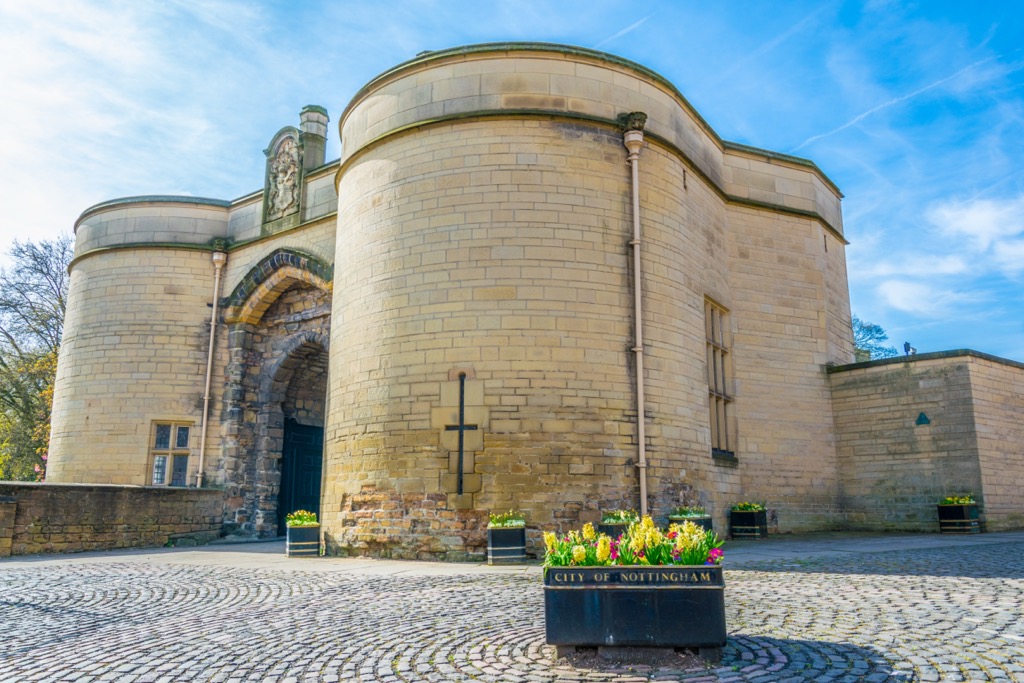
Nottingham's city center is situated on the north bank of the River Trent, with the Old Market Square, the UK's second-largest public space after Trafalgar Square, generally regarded as the heart of the city. The city's most famous landmark, the 11th-century Nottingham Castle, sits atop a natural promontory around 500 m (1,640 ft) southwest of the Old Market Square.
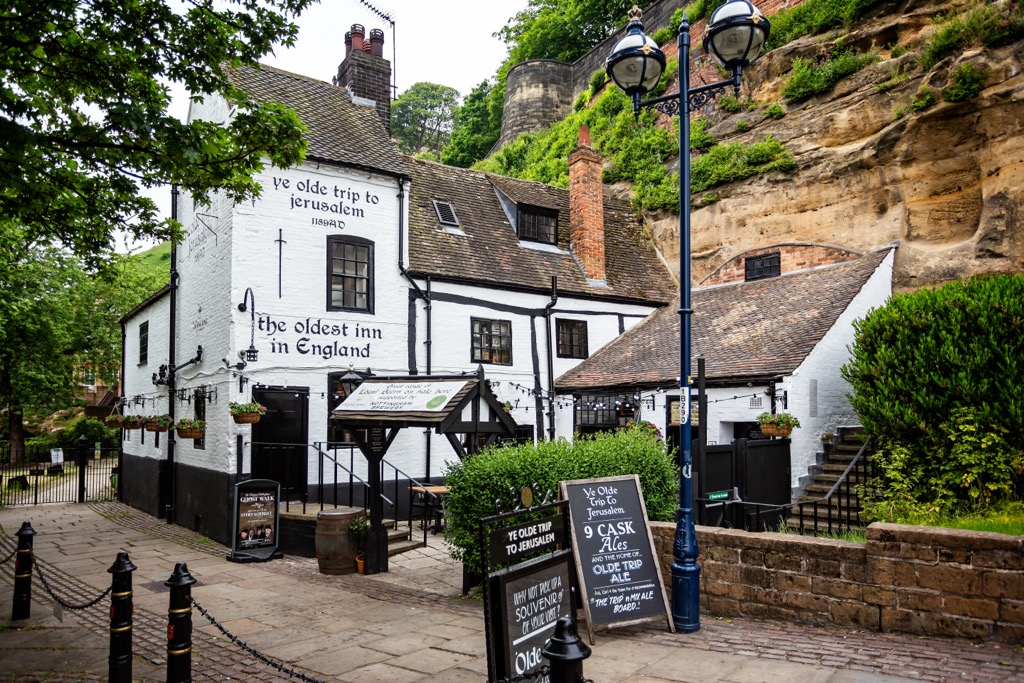
Ye Olde Trip To Jerusalem, one of several pubs nationwide that claim to be England's oldest pub, was reportedly opened in 1189 and is located just southeast of Nottingham Castle.
Nottingham's urban geological structure comprises Triassic sandstones, siltstones, mudstones, and conglomerates. One of the most important rock bands below Nottingham is its Permo-Triassic sandstone, known as Sherwood sandstone.
Sherwood sandstone is around 250 million years old and was deposited by large interconnected streams. Geologists believe inland sandflats may have been at the river basin's center, where the sandstone is thickest. This red, yellow, and brown sandstone is embedded with large pebbles and features ripples left behind from the currents of ancient rivers.
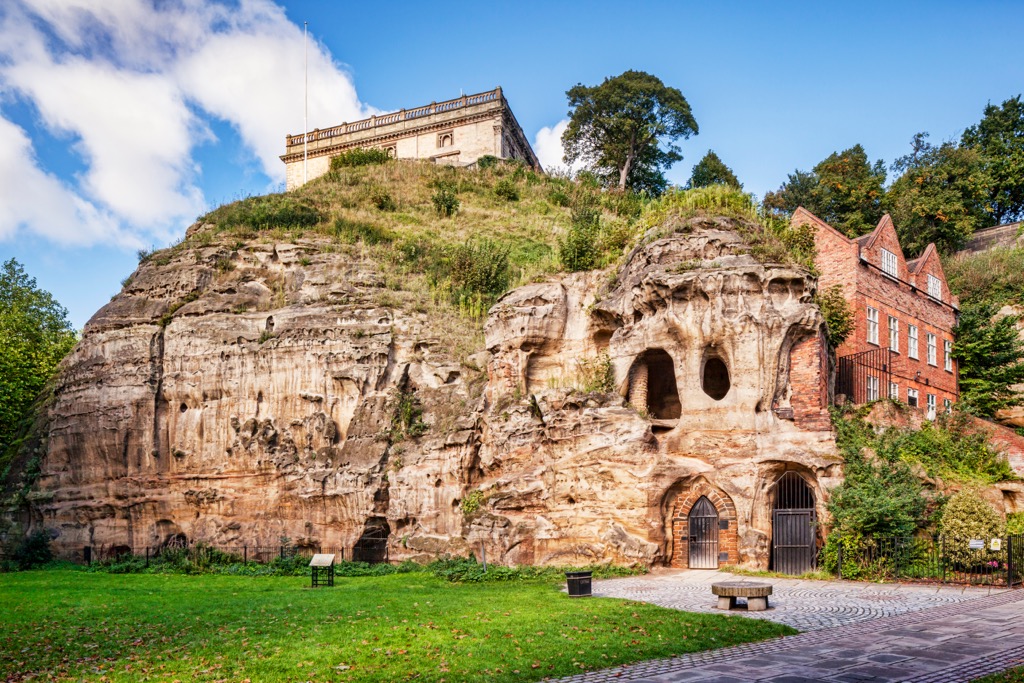
Castle Rock, the promontory on which Nottingham Castle was built, consists of Sherwood sandstone. Due to Sherwood sandstone's soft composition, over 900 caves have been dug below Nottingham, some dating back to the medieval period.
One of Nottingham's most famous cave systems is the City of Caves, a cave network that locals have used since medieval times as a tannery, slum, and pub cellar. Most recently, the City of Caves was used as an air raid shelter during the Second World War. Today, they're a popular attraction with daily tours.
With country parks and nature reserves covering hundreds of acres a stone's throw from the city center, Nottingham has a surprisingly diverse ecosystem for a large metropolitan area.
Many mammal species, including red foxes, grey squirrels, and badgers, have adapted to thrive in Nottingham's urban environment. Wollaton Park is home to herds of fallow deer and the UK's largest mammal, red deer. Otters are occasionally seen in the Attenborough Nature Reserve.
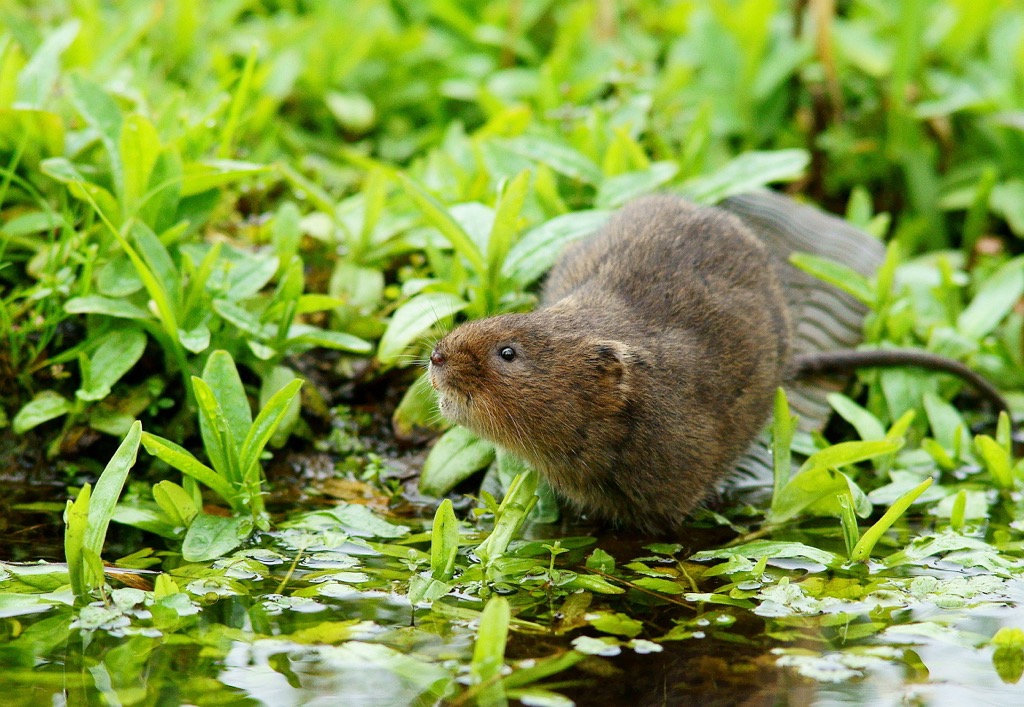
One of Nottingham's rarest mammals is the water vole — it's among the UK's fastest-declining species, with the Water Vole Recovery Project striving to preserve its dwindling population. Twelve of the UK's 17 bat species live within Nottingham, including common pipistrelles, Daubenton's bats, and brown long-eared bats.
The parks and reserves around Nottingham serve as a haven for local and migratory bird species. Attenborough Nature Reserve is a popular birding spot, with over 250 species identified in the last 60 years.
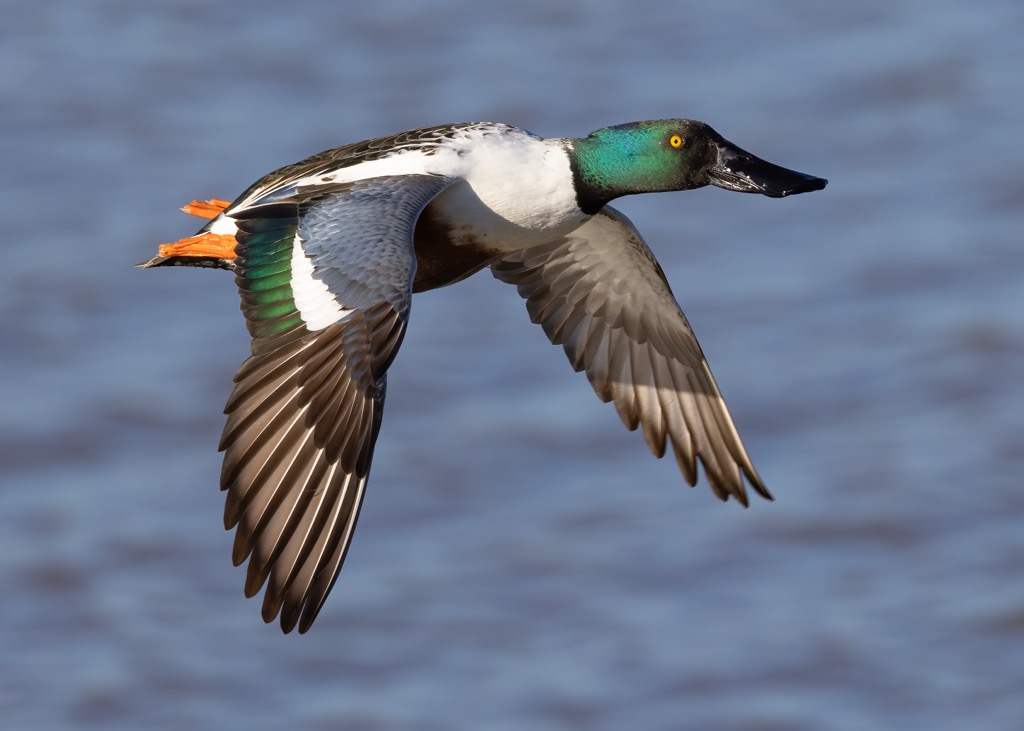
Significant populations of great crested grebes and northern shovelers spend all year at the reserve. Nationally rare bird species, like penduline tits, purple herons, and soras, have been seen in Attenborough Nature Reserve over the years. Kingfishers, sparrowhawks, and tawny owls are among the local predatory species.
Common bird species in Nottingham include wood pigeons, seagulls, rooks, carrion crows, jackdaws, sparrows, and starlings.
Reptile species in Nottingham include common lizards, slowworms, and smooth snakes. Adders, the UK's only venomous snake, are extremely rare and may even be extinct locally within the city. Common frogs, common toads, and smooth newts are among the most common amphibians.
Colwick Country Park is home to the Colwick Fish Ladder, the largest fish ladder in the UK. This series of artificial pools provides migratory fish, such as salmon and trout, a way around the Colwick Sluices on the River Trent.
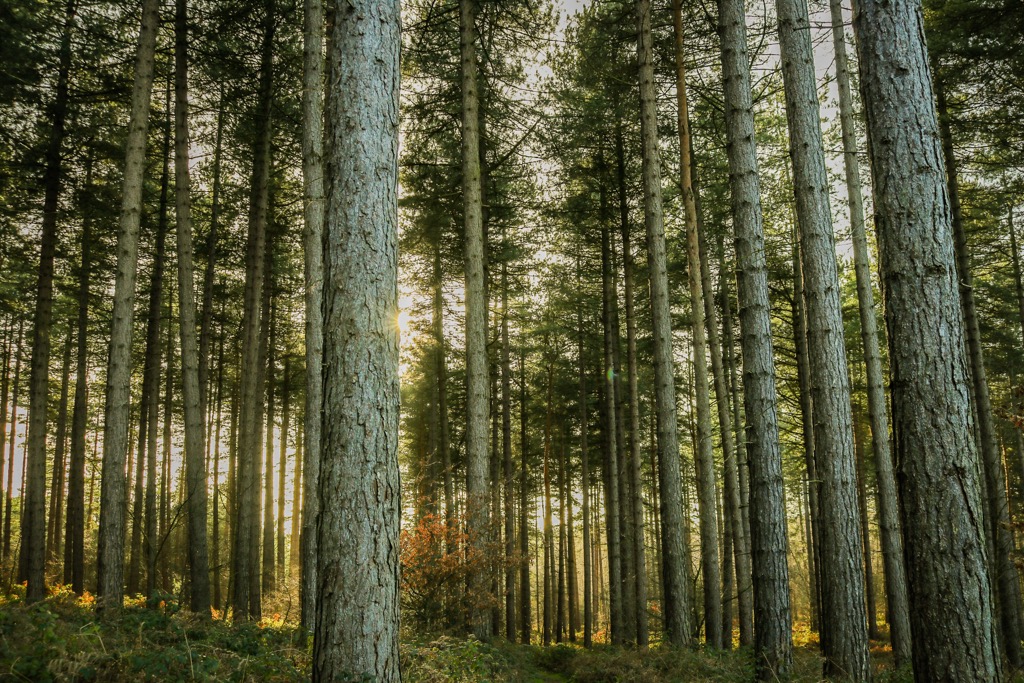
There are no extensive forests in Nottingham — large wooded areas, like Sherwood Forest, are found in the surrounding green belt. Colwick Woods is the largest wooded area in central Nottingham, covering over 92 acres (37 ha). Common trees in Nottingham include English oaks, hawthorns, sycamores, European ashes, yews, pines, and silver birches.
Sherwood Forest's most famous tree is the Major Oak, an English oak between 800 and 1,100 years old. Its trunk has a circumference of approximately 11 m (36 ft) and weighs an estimated 23 tonnes. Legends say Robin Hood and his Merry Men used to camp under the Major Oak and use it as a hiding spot.
Nottingham's county flower is the Nottingham catchfly, named because it used to grow out of the walls of Nottingham Castle. However, it's no longer believed to grow in Nottingham or the surrounding countryside.
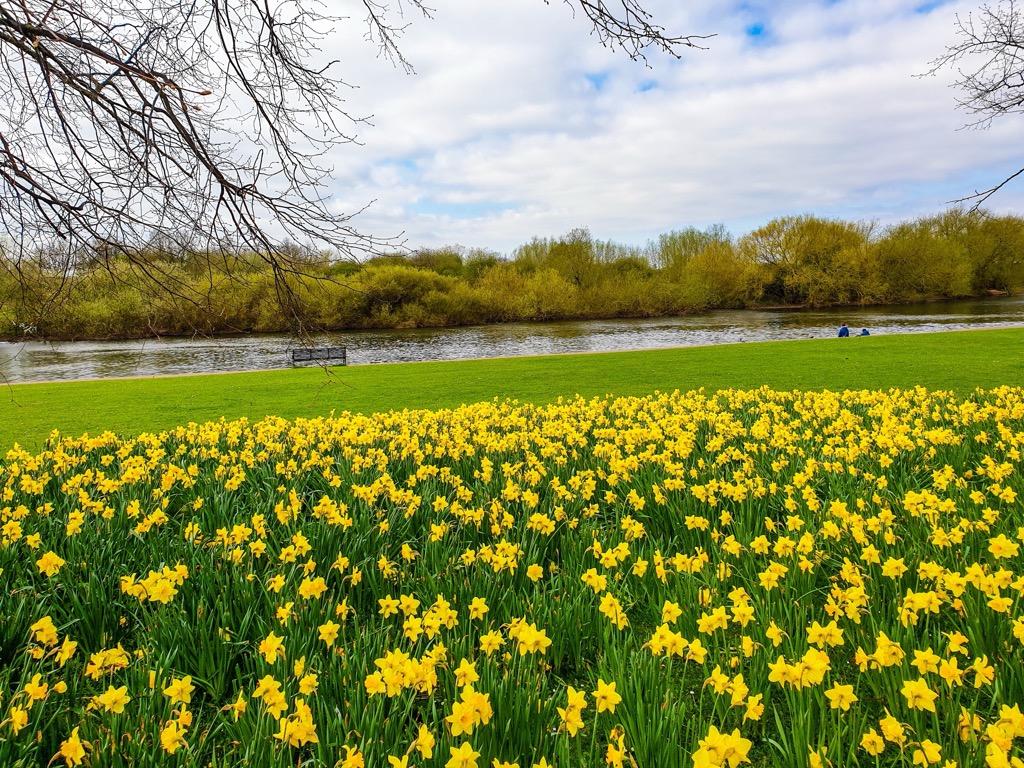
Numerous vibrant wildflower species grow across Nottingham's country parks and woodlands, including meadow buttercups, daffodils, daisies, dandelions, bluebells, common spotted orchids, Welsh poppies, red campions, crocuses, and common knotweed.
Like the rest of the UK, hiking in Nottingham didn't become a popular leisure activity until the late 18th and early 19th century. The rise of the Romantic movement saw a shift in sentiments towards hiking — previously, walking long distances was frowned upon and associated with poverty. One of the oldest hiking trails in Nottinghamshire is the Southwell Trail, created in 1842 along a former railway line.
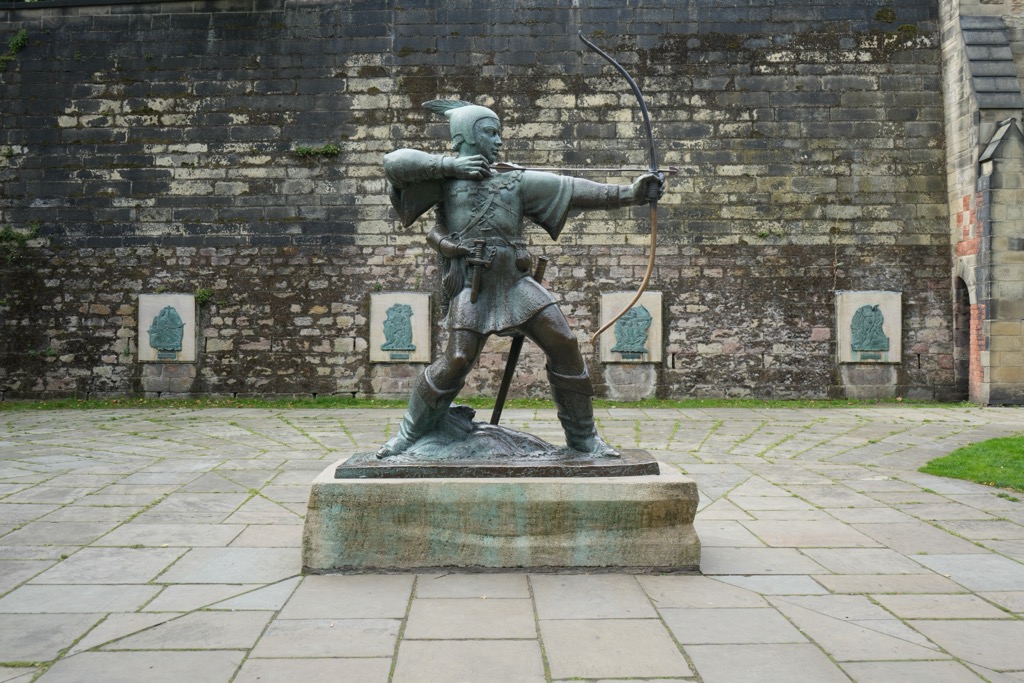
Romantic poets such as William Wordsworth and John Keats wrote extensively about nature and undertaking long-distance walks, which helped change the British public's perception of the natural world. Additionally, the legendary Sherwood Forest helped drive the popularity of hiking in and around Nottingham, with locals looking to uncover the folklore behind Robin Hood.
The Industrial Revolution also played a role in hiking's popularity — workers, usually confined to Nottingham's crowded textile factories, would escape to the countryside on weekends for respite.
As hiking became popular, questions were raised about the general public's "right to roam." Large parts of England's countryside were privately owned, making it inaccessible to new rambling groups popping up across the country.
By the 1930s, hiking had gained mainstream popularity, with thousands of people visiting the nearby Peak District every week. As hiking became more popular, parliament introduced legislation addressing the right to roam several times, but never passed it into law.
Public frustration culminated in mass trespasses, most famously the 1932 mass trespass of Kinder Scout (638 m / 2,096 ft), the highest summit in the Peak District. These efforts contributed to the passage of the National Parks and Access to the Countryside Act 1949, which led to the establishment of the UK's first national park, the Peak District National Park, in 1951.
Aside from its hiking history, Nottingham has played a significant role in the development of medicine and infrastructure in the UK and beyond. Ibuprofen, branded as Advil or Brufen in the US, was invented in Nottingham in 1961. Nottingham's Radcliffe Road became the world's first tarmac road in 1902.
Aside from the Peak District National Park—easily the best nearby hiking area—Nottingham offers several family-friendly trails perfect for casual ramblers.
Trails are often muddy in Nottingham, and the weather can be changeable, so wear appropriate footwear and check local weather forecasts before setting out.
Read our guide to the Peak District National Park for information on the best hikes in the UK's oldest national park.
Wollaton Park is Nottingham's largest city park and among its most popular nature areas. Designated as a Local Nature Reserve (LNR) in 2014, Wollaton Park covers over 500 acres (202 ha)—including a deer park—just north of the University of Nottingham. At the southern end of Wollaton Park, within Wollaton Park Golf Club, is Arbour Hill (68 m / 223 ft).
At Wollaton Park's center is the 16th-century Wollaton Hall. This Elizabethan country house has been featured in several movies — it's perhaps most famous for serving as Wayne Manor in The Dark Knight Rises. Wollaton Hall has been home to the Nottingham Natural History Museum since 1926.
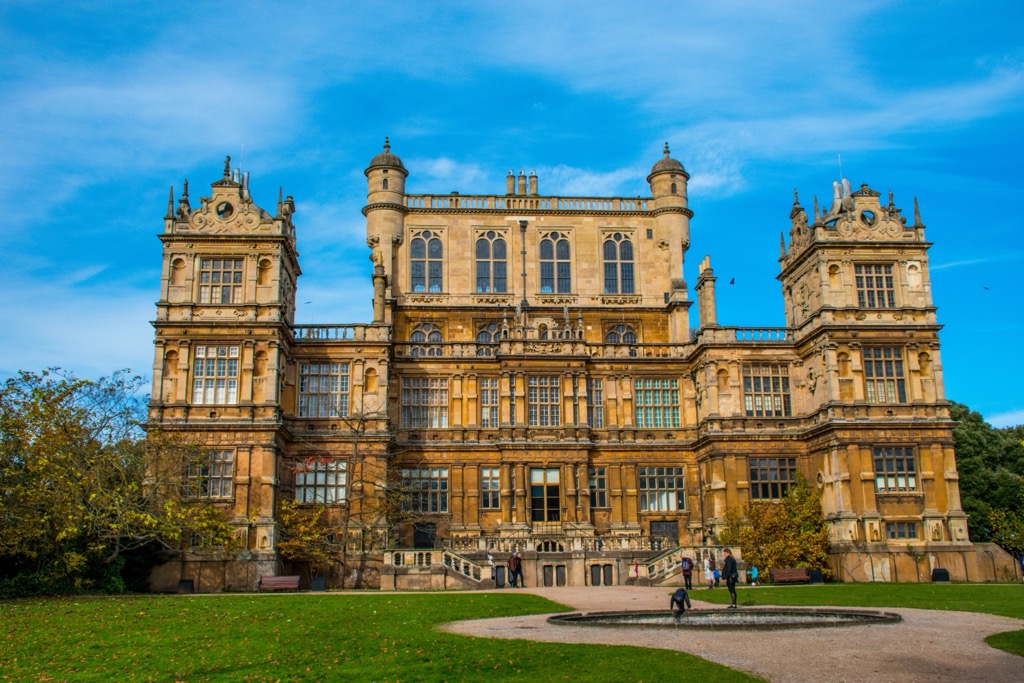
Hiking, biking, birding, and dog walking are all popular activities in Wollaton Park. The most popular trail in Wollaton Park is the Wollaton Park Circular Walk.
You can pick up this trail from the Wollaton Park car park beside the botanical gardens. The clear paved trail leads past the Nottingham Industrial Museum before turning left along the edge of Thompson's Wood and looping around Wollaton Park Lake. You'll return to your starting point via the boundary of the golf course on the far side of the lake.
The Wollaton Park Circular Walk is approximately 3.1 km (1.9 mi) long. You can find a map of this looped walk here.
Nestled along the River Trent, the Attenborough Nature Reserve comprises 540 acres (220 ha) of reclaimed wetlands less than 4 mi (6.4 km) from Nottingham's Old Market Square.
It's an essential habitat for native bird species and is home to the country's largest population of shovelers and diving ducks. Other species include bitterns, kingfishers, cormorants, and widgeons.
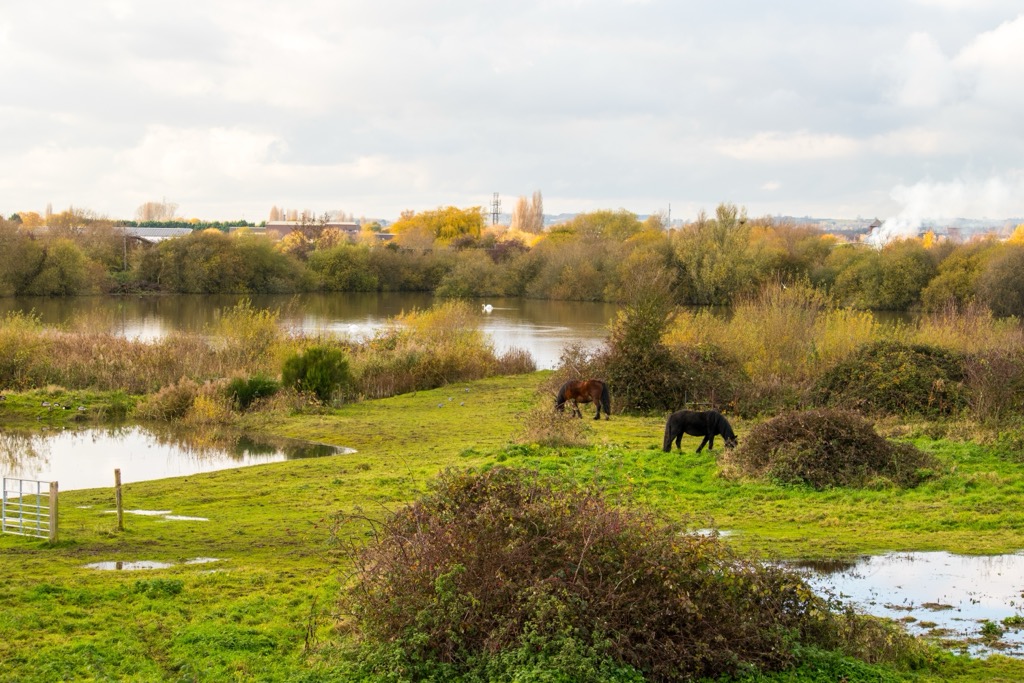
There are three main trails in the Attenborough Nature Reserve, each named after bird species. One of the most popular paths in the reserve is the circular Skylark Trail. You can pick up this hike from the Attenborough Nature Reserve car park on Bartons Lane.
This trail loops Coneries Pond via the Attenborough Sailing Club on the southern side of the reserve before returning along the River Trent. Just after Coneries Pond, Erewash Field is a nesting site for skylarks, meadow pipits, and grasshopper warblers in spring and summer. Stonechats and snipes are familiar sights in winter.
The Skylark Trail is approximately 2.6 mi (4.1 km) long. You can find a full breakdown of the Attenborough Nature Reserve's trails here.
On the eastern fringes of Nottingham is Gedling Country Park, one of the best places to see the city's skyline. Built on the site of a closed-down mine, Gedling Country Park covers 580 acres (234 ha) of woodlands and meadows. It features a children's play park and a visitor center. At its southern edge is a lagoon and the River Trent.
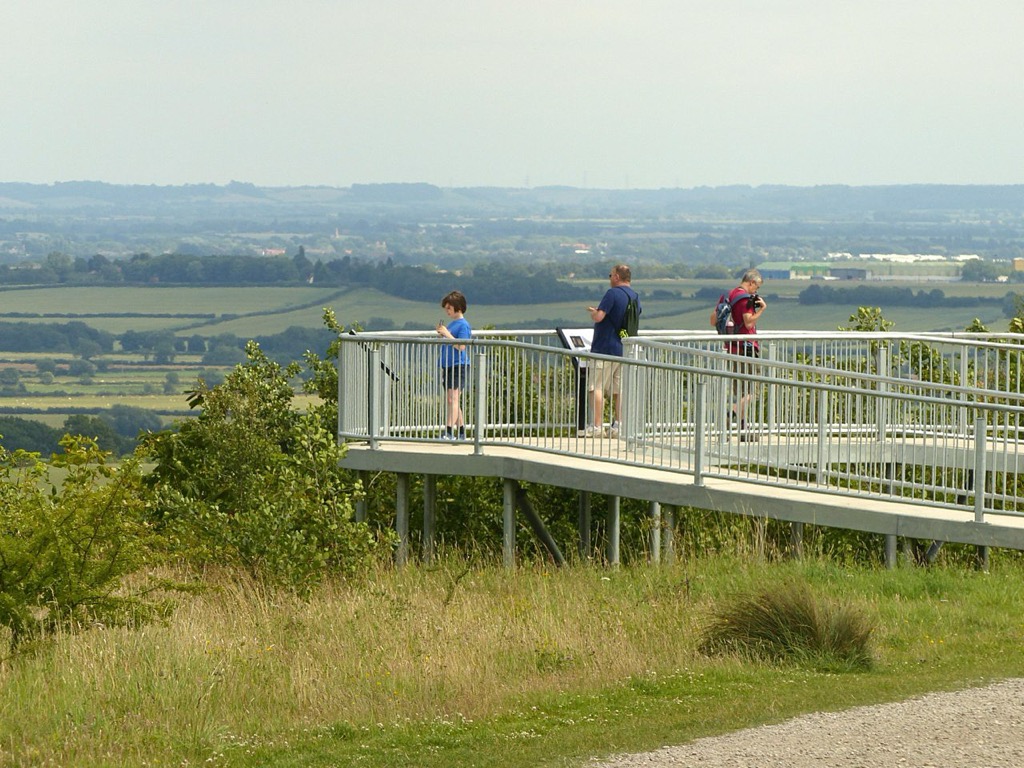
There are four color-coded trails in Gedling Country Park, the longest and hardest of which is the Low Hazles. From the Gedling Country Park car park, follow the green trail as it loops around the park's edge.
You'll pass the south and north viewing platforms, which provide panoramas of Nottingham as far as Lincolnshire and Leicestershire. From these platforms, you'll be able to spot Lincoln Cathedral, once the tallest building in the world, until its spire collapsed in 1549.
The Gedling Country Park Low Hazles trail is approximately 3.5 mi (5.7 km) long. You can find a map of the park's trails here.
No trip to Nottingham would be complete without a stroll around the legendary Sherwood Forest. Located around 30 mi (48 km) north of Nottingham near Mansfield, Sherwood Forest National Nature Reserve encompasses over 1,049 acres (424 ha) of ancient woodlands that have existed since the reign of William the Conqueror.
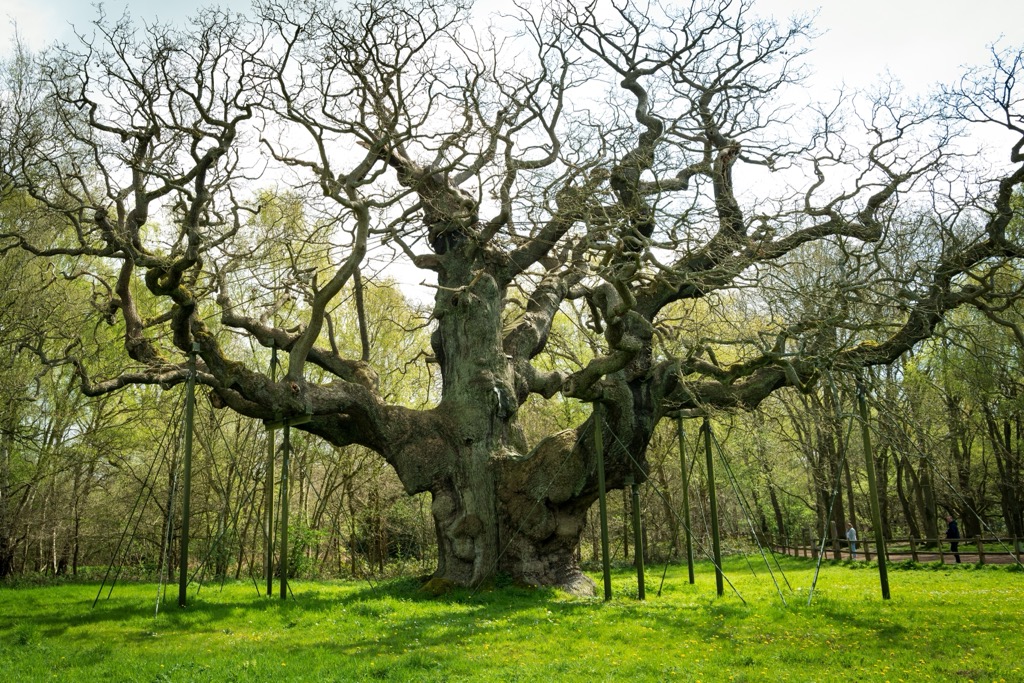
Several trails weave through Sherwood Forest, but the most popular is the Major Oak Trail. This short track leads from the Sherwood Forest Visitors Centre along a mix of paths and bridleways to the thousand-year-old Major Oak, which legends say served as a hiding spot for Robin Hood. This massive English oak has a canopy around 28 m (92 ft) wide and can produce as many as 150,000 acorns annually.
The Major Oak Trail is roughly 1.5 mi (2.4 km) long and takes between half an hour and an hour to complete. You can find a map of Sherwood Forest's trails here.
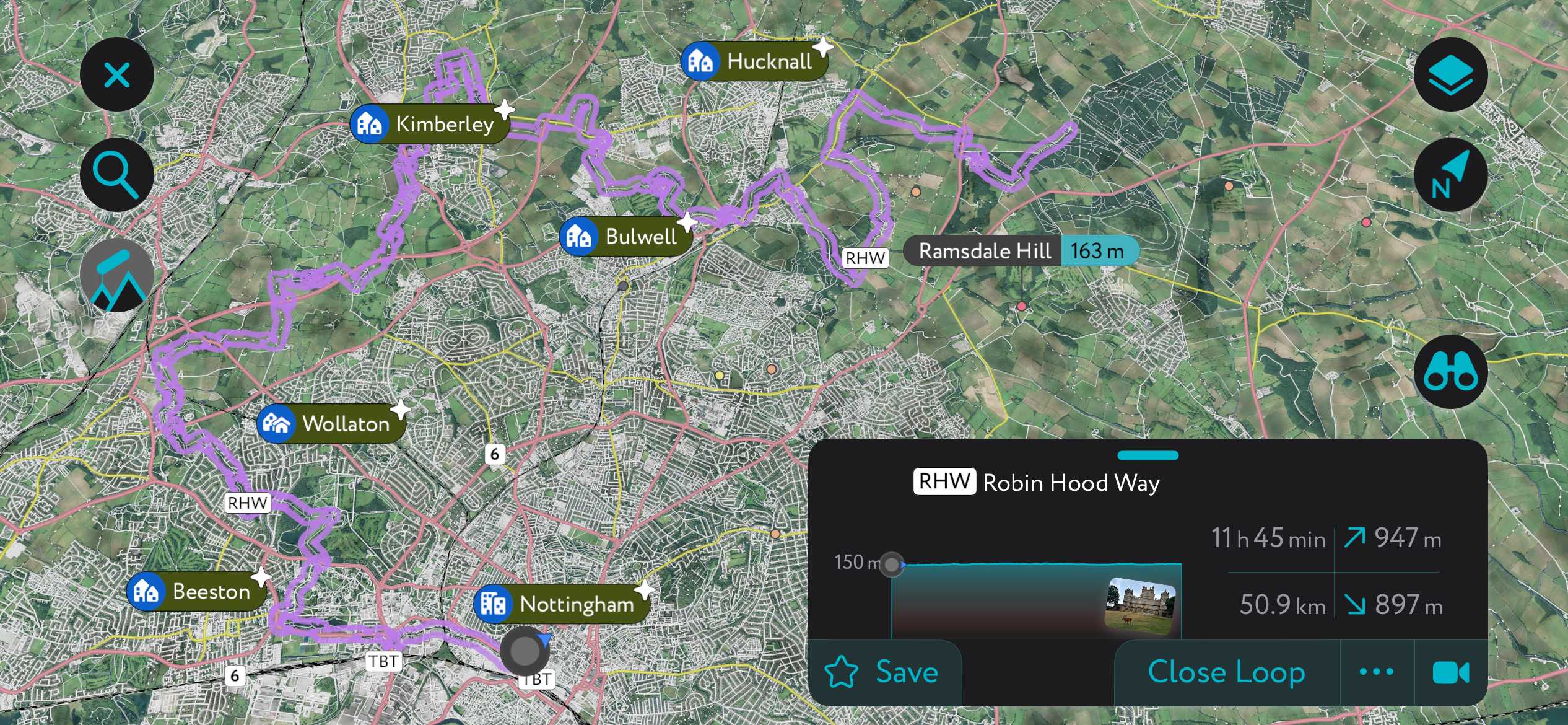
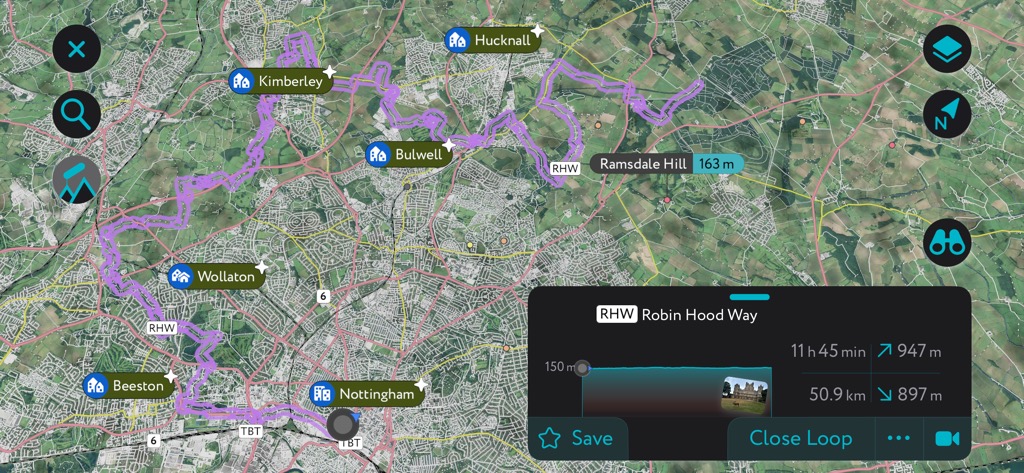
The Robin Hood Way is the best long-distance hike in Nottingham, running for roughly 110 mi (177 km) across the length of Nottinghamshire from Nottingham Castle to Edwinstowe.
The route aims to connect all places in Nottinghamshire linked with Robin Hood, leading past Ye Olde Trip to Jerusalem, the Major Oak, Robin Hood's Well, Robin Hood's Cave, Robin Hood Hill (143 m / 472 ft), Creswell Crags, and Worksop Priory.
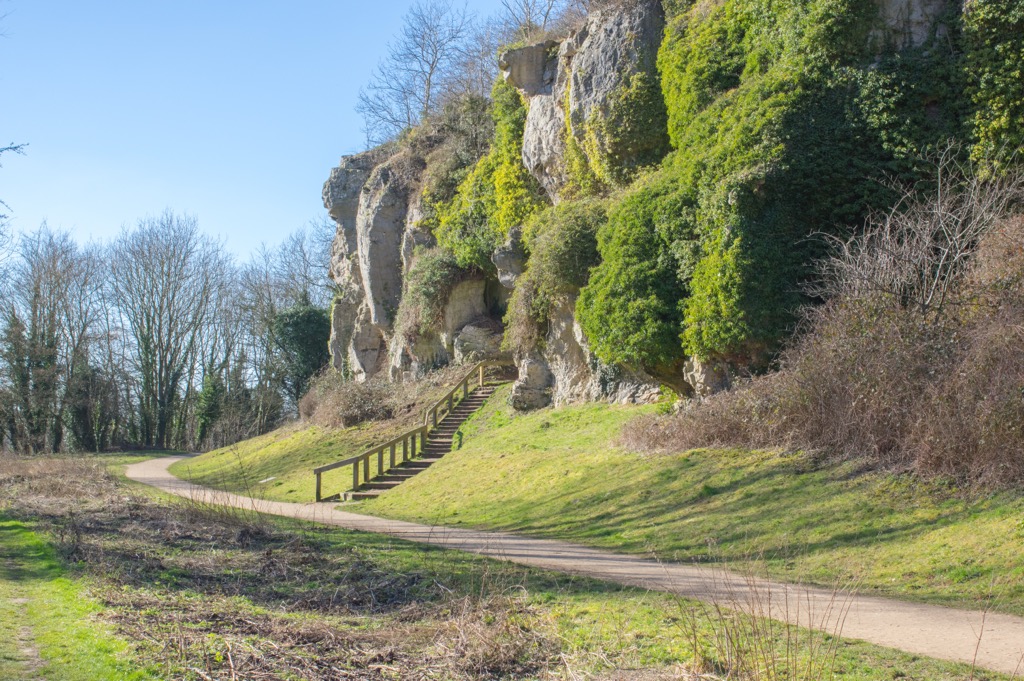
Aside from famous sites like Sherwood Forest, Creswell Crags is one of the highlights of Robin Hood Way. This limestone gorge is home to the northernmost cave art in Europe, and there’s evidence Neanderthals lived in its caves 60,000 years ago. Its ancient caves and limestone rock faces make it one of the most interesting places to explore on the Robin Hood Way.
Another highlight is Robin Hood Hill, one of the highest points on the Robin Hood Way. It's a promontory home to the remnants of a 3,000-year-old Bronze Age burial mound. Fragments of Roman pottery and dozens of Roman coins have been uncovered at the site.
You can find a map of the Robin Hood Way by the Long Distance Walkers Association here. You can buy the official guidebook for Robin Hood Way here.
At PeakVisor, we love information. That’s why we write articles like this one.
Check out the PeakVisor app for even more information on thousands of additional hikes, ski tours, and ski resorts across the world. In fact, we’ve compiled information on all publicly maintained walking tracks worldwide, formatted onto our 3D maps.
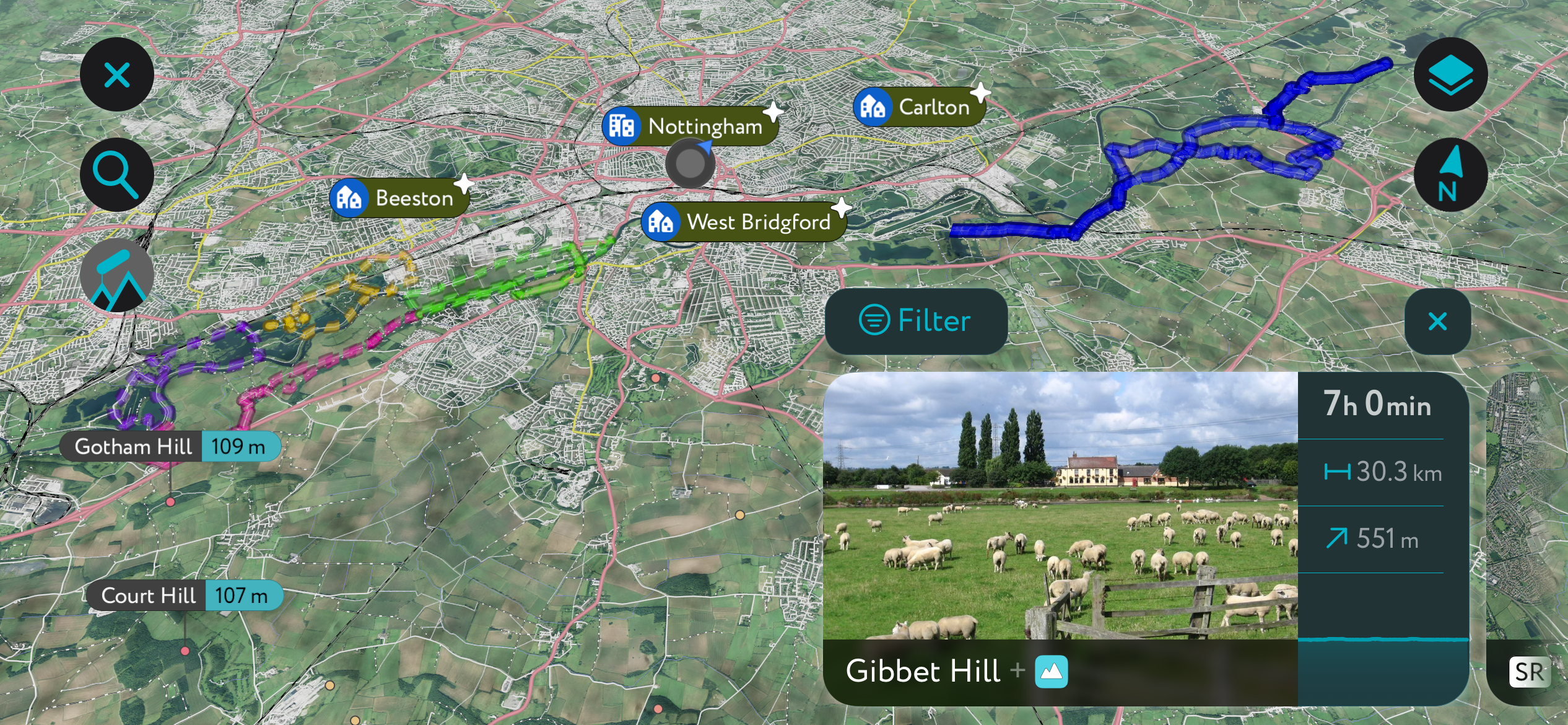
PeakVisor started as a peak identification tool—you’ll have noticed the photos throughout this article—but we’ve evolved into purveyors of the finest 3D maps available. We continue to expand our offerings. You can track your hikes directly on the app, upload pictures for other users, and keep a diary of all your outdoor adventures.
Most recently, the PeakVisor App has included up-to-date weather reports, including snow depths, at any destination. We've also been hard at work adding the details of hundreds of mountain huts, including information on overnight accommodation, dining options, and opening hours. You can also use our Hiking Map on your desktop to create .GPX files for routes to follow later on the app.
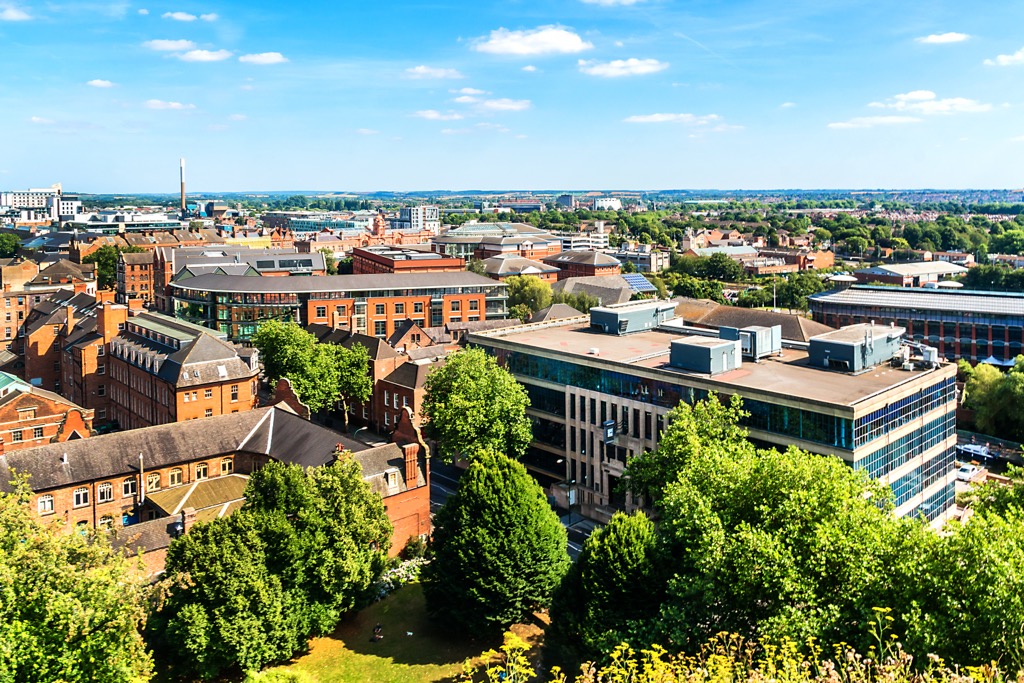
World-famous British folklore, architectural wonders, and manicured country parks await visitors to Nottingham and its nearby towns.
Nottingham East Midlands Airport is the nearest international airport to Nottingham, located 10 mi (16 km) from the city center. Nottingham East Midlands Airport offers services to destinations across Europe, including Dublin, Barcelona, Vienna, and Naples.
Consider staying in the heart of Nottingham if you're looking to visit the city's top tourist attractions. From Nottingham Castle to Wollaton Hall, there's no shortage of top-class attractions in Nottingham. Take a tour of the National Justice Museum, reported to be one of the most haunted buildings in the UK, or uncover Nottingham's subterranean history in the City of Caves.
Nottingham Castle marks the starting point of the Robin Hood Way, and with Sherwood Forest less than 25 mi (40 km) away, there's no better place to stay to learn about one of the UK's most famous legends, Robin Hood. Wollaton Park, Attenborough Nature Reserve, and Colwick Country Park are all within walking distance of the city center if you have to escape the busy city streets.
Nottingham is a well-connected city — its train station has direct services to London St. Pancras, Manchester Piccadilly, and Cardiff Central.
Beeston is one of the best satellite towns to stay in if you want to avoid central Nottingham. Beeston has a population of over 37,000, situated less than 5 mi (8 km) southwest of downtown Nottingham.
Beeston is the ideal base for exploring the Attenborough Nature Reserve, which is located just south of the town. Beeston is closely associated with the University of Nottingham, which is just northeast of the town center.
With its weekly markets, independent shops, excellent restaurants, and extensive green spaces, Beeston ranks as one of the best places to live in Nottingham. Beeston train station connects directly to Derby and Nottingham.
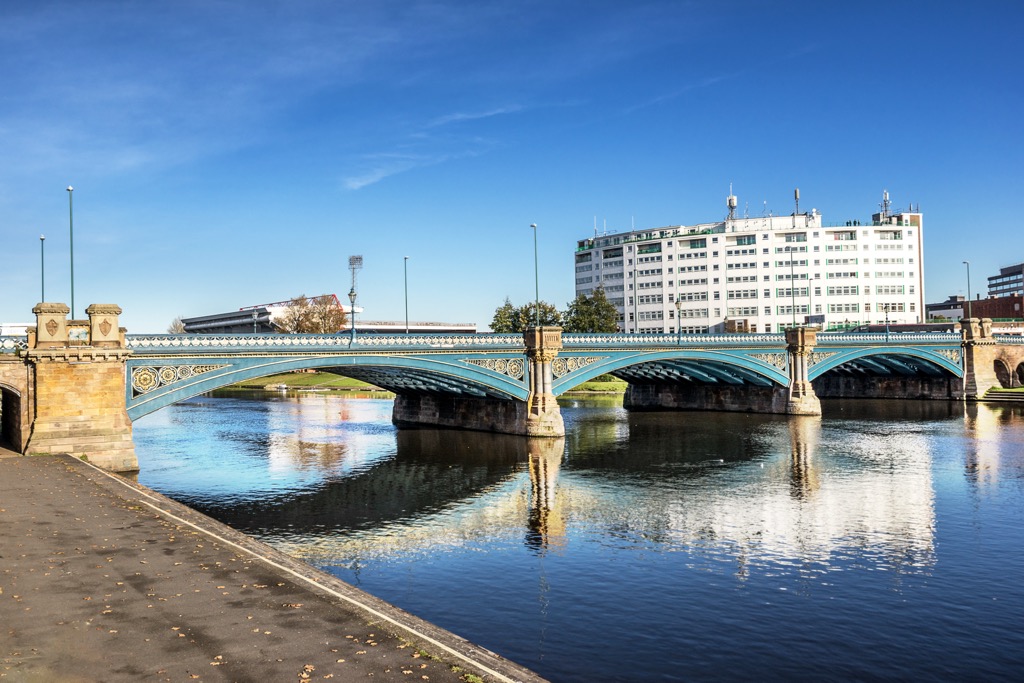
Check out West Bridgford if you fancy staying on the south side of the River Trent. Like Beeston, West Bridgford is a large town adjacent to Nottingham, with a population of over 36,400.
West Bridgford is the perfect place to stay to catch some local sport — it's home to Trent Bridge, the oldest test cricket ground globally, and the City Ground, home to Nottingham Forest F.C. You'll find a couple of good local walking spots in West Bridgford, including the Green Line and Holme Pierrepont Country Park.





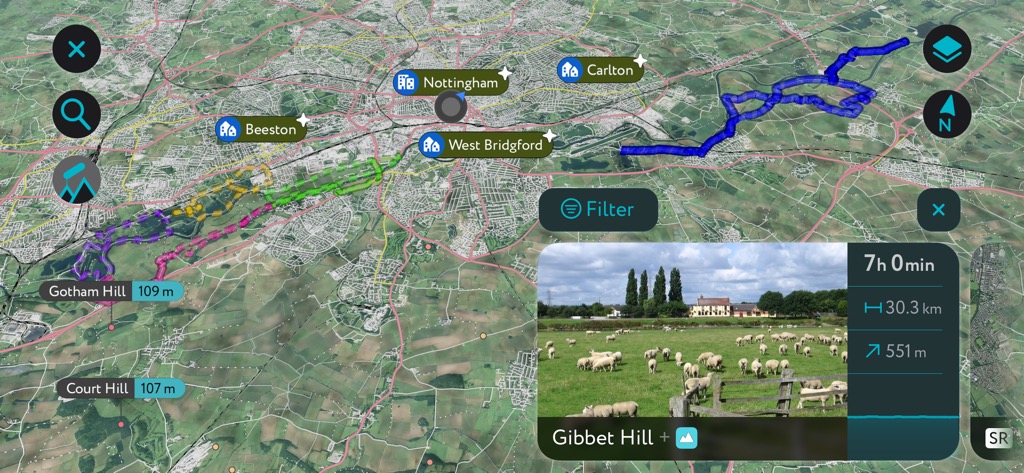


Yes. City of Nottingham has 5 named mountains. The highest is Mapperley at 134 m.
The highest mountain in City of Nottingham is Mapperley, at 134 m.
City of Nottingham has 5 named mountains.



.jpg)

